At Panjim’s Church of the Immaculate Conception (Igreja Matriz or main parish church), the sixth Sunday of Lent begins on a festive note. This is Palm Sunday, which commemorates the triumphant entry of Jesus into Jerusalem.
However, after the morning Masses, there is a visible change in the mood, especially with the unveiling of the tableau in the chancel: a huge statue of Christ carrying the Cross. Hence, the alternative designation of the day, or of its second half: Passion Sunday.
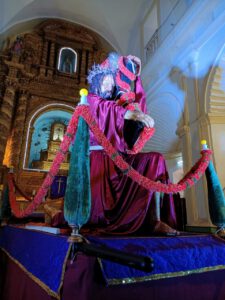
Passion Sunday
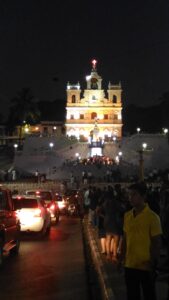
The Passion Sunday evening features a solemn procession that begins and ends at the iconic church. This is the highpoint of the Santos Passos (‘Holy Steps’) held on the first five Sundays of Lent, highlighting some of the most intense moments of Christ’s Passion leading to Calvary: Agony in the Garden of Gethsemane, the Arrest of Jesus, the Flagellation at the Pillar, the Crowning with Thorns, and the Condemnation by Pontius Pilate (See my blogpost https://www.oscardenoronha.com/2019/03/17/santos-passos-in-panjim/ ). Not all churches in Goa necessarily have the same set-up (See https://www.oscardenoronha.com/2021/03/21/lenten-traditions-in-goa/ ).
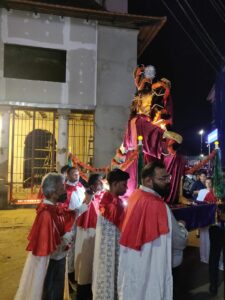
Passion Sunday signals the beginning of Holy Week. The predominant colour is purple; the altars are bare, and flower arrangements absent. After the evening Mass, a procession called Cruz às Costas—the said tableau of Jesus carrying the Cross—first wends its way through these public spaces of the capital: the Church square; a section of 18 June and Pissurlencar Streets, and Azad Maidan (formerly called Afonso de Albuquerque Square).

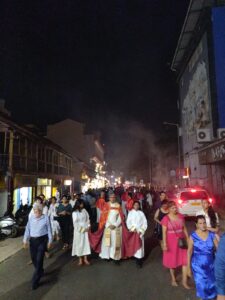
Confrades (Church confraternity members) wearing opa e murça (red and white cape) carry the statue concertedly, and one gets the impression that it is floating on its own power (Figure 1). In the past, a brass band would follow, but nowadays, a choir sings from an intermediate landing of the church’s zigzag stairway. Singing and prayers are heard throughout the route via funnel loudspeakers. The faithful file past, reciting the five Sorrowful Mysteries of the Rosary until the end of the procession.
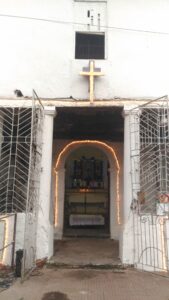
Over ten descansos (halts) mark the circuit. At those points the faithful flock to kiss the statue. There is a major halt at the Capela da Conceição (Chapel of the Immaculate Conception). Built in 1823, it was once a private chapel attached to the mansion of Dom Lourenço de Noronha, a Portuguese nobleman. The chapel was bequeathed to the Confrarias (Confraternities) of Panjim Church and has been under repair since 2019.
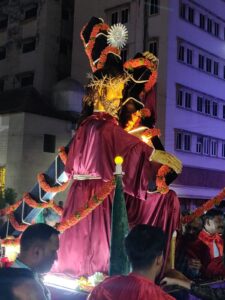
The cavalcade then proceeds via Mahatma Gandhi and Dr Domingos Roque de Sousa Streets, past the Garcia de Orta Garden, up to the church square. At the foot of the stairway, Jesus meets His Mother, Mary. Sorrowing over her Divine Son so unjustly accused and made to carry the Cross to His death, she accompanies him on his last legs, as she did at Golgotha two thousand years ago.
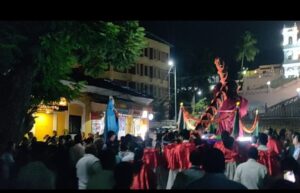
Soon thereafter, the two statues halt on the intermediate landing in front of a large wall cross. A level higher, from a narrow, pulpit-like balcony, a little girl unrolls a Veil of Veronica while she sings the traditional narrative about the legendary woman’s meeting with Jesus. As recorded in the fourth station of the Via Crucis, Veronica, moved by the sight of Jesus carrying the Cross, wiped his brow with her handkerchief only to find a lasting imprint of His holy face on the cloth.
Thus ends Passion Sunday, and on the evening of Maundy Thursday preparations get underway for the Holy Triduum. The evening Mass, with the traditional washing of the feet, marks the institution of the Eucharist and the priesthood and the proclamation of the commandment of love. No public procession is held.
Good Friday
On Good Friday, the processional arrangement is similar that of Passion Sunday, except for a few necessary differences.
The poignant Crucifixion tableau opens in the chancel at 3 o’clock in the afternoon. Interestingly, the sky is usually cloudy and the mood is sombre by then. The liturgy of the Word and the Eucharist continue until about half past five. Then, a procession of a recumbent larger-than-life-size statue of Senhor Morto (The Departed Lord) placed on an andor (black canopied wooden platform) starts off, with the statue of Our Lady in trail.
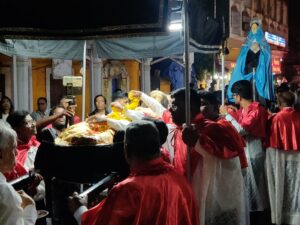
On this day, the faithful are in funereal attire, which once was de rigueur. Instead of the Sanctus bell, one hears the matraca or wooden rattle, at every halt in the procession.
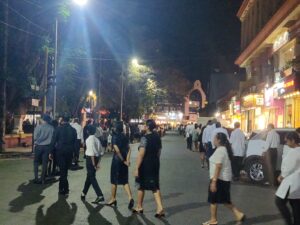
A major difference between the Passion Sunday and the Good Friday procession lies at the end of this baroque event, when a priest delivers a Sermão da Soledade de Maria (Sermon on the Solitude of Mary) from the same pulpit-like balcony. The preacher extols Mary’s virtues and highlights her interior disposition. Previously, rhetoric played a crucial role on such occasions, helping to fully engage the congregation. Nowadays, one finds a limited number of faithful, who are easily distracted, not least by traffic noise that further detracts from the solemn ambience.
Moving spectacle
A striking similarity between the processions is that both are watched in awe by people of other religions, including policemen who stand at attention and especially salute the Departed Lord.
On both occasions, residences along the route set up decorative lights, candles, or oil lamps in homage to Our Lord. Some non-Christian establishments that are open, as it is a working day, do likewise. The case of the Caculos and the Neurencars, two Hindu homes on Pissurlencar Street, is particularly interesting; they traditionally offer xênvtim (chrysanthemum) or abolim (crossandra) garlands.
On both days, depending on the number of attendees, the pious, kilometre-long march and related ceremonies take between 75 and 90 minutes. The statues return to the church for the concluding rites and veneration. By 8 o’clock, they call it a night!
These two processional events have left a lasting imprint on my mind. So was it when my life began; so is it now that I am a man. And so be it when I grow old—for this ancient tradition is undoubtedly one of the most moving spectacles in the religious and cultural calendar of my city, Panjim.
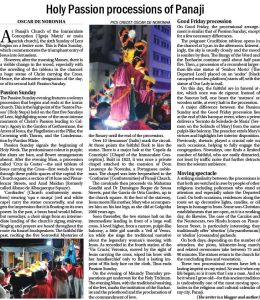
Also published in Revista da Casa de Goa, Series II, No. 39, March-April 2026, pp 43-47;
Zest magazine, The Navhind Times, Panjim, 27 March 2026, p. 1
Requests:
1- In the comments section below, do share snippets of similar traditions in your village or city, and document them whenever possible.
2 – Do watch my video titled “Passion Sunday Procession in Panjim”, on http://www.youtube.com/@oscardenoronha
Thank you for the very interesting account of the two processions, Oscar.
Thank you for the detailed account of the two holy processions that continue to hold much significance. May they never fade.
Your writing is so graphic Oscar, it’s like watching a video.
Traffic noise is a big distraction, cell phones even bigger…