Abbé Faria: one of Goa’s first global citizens
Link to the original interview in Portuguese on Renascenca Goa podcast https://www.youtube.com/watch?v=wnBCV6fCgTI
ON: September this year [2019] is the month of Abbé Faria, marking two hundred years since his passing… Let’s start by talking about your interest in Abbé Faria…
ISRV: I have such great respect for Abbé Faria that I believe every year is a year dedicated to Abbé Faria. His contribution, in so many ways, is something we must not forget, and I am delighted that you have taken an interest in this figure, this subject and this date.
The person who first planted the seed in my mind to undertake a slightly more in-depth study of Abbé Faria was Mr Matanhy Saldanha. He invited a few people round for tea and discussed whether it might be possible to do something — let’s say, a small museum or some other activity — to honour the great figure of Abbé Faria. At that time, Mr Matanhy Saldanha was a member of the Government, but a few months later he was no longer in government, and the whole project fell through.
But I didn’t lose interest. I’d already started reading up on it, and at that point I discovered that, many years earlier, my brother, Luís, had written an article. When I read that article, I became even more interested, and both Luís and I continued to do a bit of research. He did far more than I did, but I made use of the information he’d gathered to carry out some work of my own later on.
That’s when my interest really took off. But we found more and more information, and more and more people who had, in one way or another, been in contact with Abbé Faria, so it turned into a truly fascinating journey.
FILM ON FARIA
ON: How did you take this interest further? Did you make a film?
ISRV: Yes, I took part in a short course in film-making or video-making. And when we reached the end of the course, each of us had to decide on a project, based on how we would have made a film. When one of my classmates, Cecil Pinto, and I began to delve deeper into our interest in Abbé Faria, we thought, why not make this documentary?
By that point, I already had plenty of material, so the idea for a documentary emerged, and we decided that, since there were people around us who had the relevant knowledge, the film should be interview-based…
ON: To prepare for this documentary, In Search of Abbé Faria https://www.youtube.com/watch?v=2mdL24UOXVs, can you tell us which authors you read and the people you spoke to, because, nowadays, finding people who know about Abbé Faria’s life must be quite rare…
ISRV: The Central Library was a very rewarding place for me because I was able to read what Egas Moniz says about Abbé Faria, what Gelásio Dalgado says about Abbé Faria, and a whole host of newspaper articles… Gomes Catão and various other people who wrote about Abbé Faria… It’s all on record…
ON: I hope we’ll now take an interest in the information you have provided, given that the Library is really very well organised…
ISRV: Very well organised indeed, and with such a rich collection… And if anyone shows an interest in reading something, they help — they really do help — and it was easier because my brother Luís had already looked into several of these authors, so I knew where to go and what to read…
RESEARCH ON FARIA
ON: You already had some leads… But when you spoke to people, did you find anything new, or was it just a repeat of what was in the books?
ISRV: We found two people. We knew these people existed, but we got in direct contact with them: one was the Russian Professor, Mikhail Buyanov. We sent him an email and he replied. He wasn’t very fluent in English, but he replied through a colleague. And we’d already read the chapter in his book Psychiatry and You.
We also contacted a lady, an Italian teacher, who has written several books on Portuguese theatre. She was an Italian, no doubt, but Portuguese at heart, so to speak. She told us things that really made our trip even more interesting… She told us that both she and her husband had collected a great deal of material on Abbé Faria. She was unable to share it with us because, meanwhile, she passed away: Luciana Stegnano Picchio.
So, for those in Italy, it’s quite possible they’ll get more material. And I’m sure there must be more newspapers in France, as well as other records in churches and various other places, and scholars too – perhaps more recent ones…
ON: And in Goa?
ISRV: Here in Goa, we’d already contacted people. We already had an idea of what they knew, but sometimes we came across additional information. For example, Dr Manohar Sardessai. Certain things he said stuck in my mind. The story that the Abbé was supposedly imprisoned at the Château d’If: it’s not history, it’s perhaps a legend.
But what Professor Sardessai said was that here in India, legend is more important than history, and that history does not become reality until it turns into a legend... So, if we think of it in this way, Abbé Faria is as much history as he is legend…
ON: That is why Abbé Faria continues to live on… Did you find any of Faria’s relatives?
ISRV: We were very lucky to find Mr William Faria in Candolim – a great-grandnephew, I believe. We visited Mr Faria and when the film was screened in Panjim, he attended… He was already over 80 years old.
I’d also like to mention that we visited Abbé Faria’s house in Colvale. It was already in ruins by then, but there was a sign that read ‘Solar dos Farias’ (Faria Mansion). It was a beautiful house, though in ruins, and in such a lovely spot overlooking the river and the beach…
ON: Is it the same one with a chapel nearby? Doesn’t it belong to José Nicolau da Fonseca?... It isn’t Abbé Faria’s original house, is it?
ISRV: I think part of it was original and was rebuilt, and now even the part that was rebuilt is completely in ruins…
ON: Well, the people you spoke to must have said something new. Do you remember anything?
ISRV: There are certain things that were said which we can’t really confirm. For example, Professor Mikhail Buyanov spoke of the chess set that was enlarged by Abbé Faria: these things are unheard of in Goa. Perhaps it’s true, perhaps it isn’t, but it’s also an interesting legend…
ON: Did Buyanov ever visit Goa?
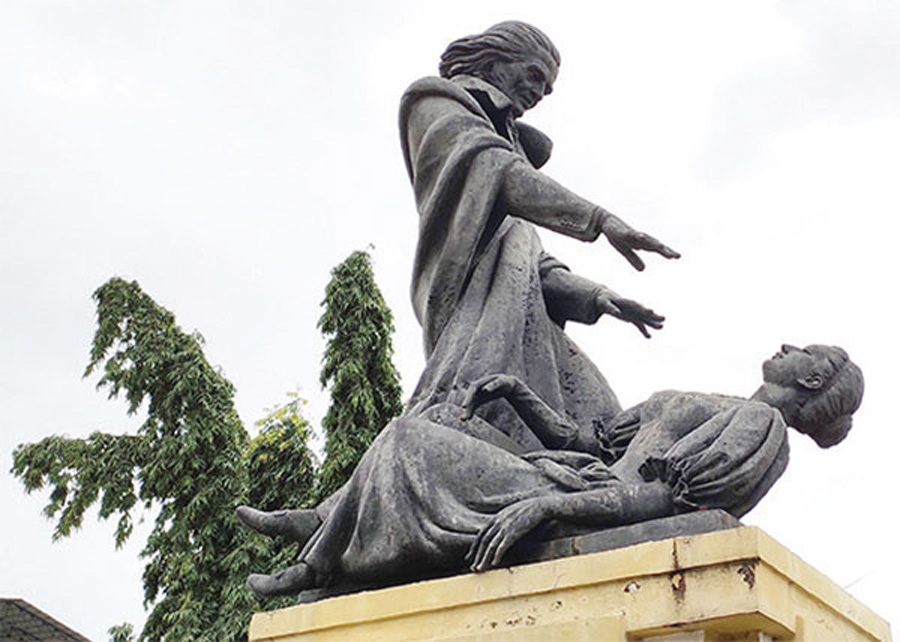
ISRV: Yes, he did, and we have a photograph of him near the statue of Abbé Faria.
FARIA’S LIFE
ON: Moving on to Abbé Faria’s life. What were the key milestones in the life of José Custódio de Faria?
ISRV: There were various stages in his life, and all of them, I think, left their mark in some way on his heart. For example, his childhood, the years he spent in Goa aged 14 and 15: I think they must have had a significant influence on him.
One person who is forgotten, let’s say, has not been forgotten by me, for in the play I wrote about Abbé Faria titled Kator Re Bhaji, one of the main characters is Catarina, who was José Custódio’s adopted sister. I am convinced that this girl, who was more or less the same age as José Custódio, must have had some influence on his imagination. When he was in Lisbon – and both he and his father had lost touch with Goa — he wrote a single letter to a neighbour in Candolim and sent an oratório (oratory) to his sister Catarina. One wouldn’t send an oratory to someone for whom one has no affection whatsoever. So, for me, that oratory is a symbol of the attachment he felt for Goa.
Furthermore, in the book he wrote [De la cause du sommeil lucide — On the Cause of Lucid Sleep], there are words in Konkani. He speaks of ‘mutt marop’, ‘tel lavop’, which shows that his childhood was not very different from ours in Goa: the same sort of family, the same family care… So, I think his time in Goa was important in his life.
Then there was the journey to Portugal by boat: what a great adventure! In Lisbon, father and son knew the language and had some contacts, but I think Rome must have been even more interesting — for the father, but even more so for the boy — because he was going there to study, and there must have been teachers, libraries, and books there that made him think of a wider world.
He returned to Portugal and I think that marked a third phase, which must have been quite difficult. We’ve spoken of the ‘Kator re bhaji’ that the father said to his son… Was the father referring only to that particular speech, or to the whole of life — the future that lay ahead of this young man — which wasn’t going to be easy?
What’s more, the father soon found himself shut away in his own home, and the boy had to leave for France. He spent a significant part of his life in France, where he was very well known, and then became completely disoriented because people made fun of him. He died utterly destitute and humiliated.
FARIA’S FATE
ON: One thing that strikes me is that this family never met again…
ISRV: I get the impression that the father always wanted to return because, when he arrived in Rome, he tried to buy the typefaces for Malayalam and Tamil. He was a scholar. He had a love for India and a nativist streak, as we say; so, I’m convinced that they intended to return, but the political situation was such that they were never able to…
ON: His gesture towards Catarina reveals the affective side of José Custódio de Faria. Don’t you think this is a side of Abbé Faria that hasn’t received much attention?
ISRV: For me, personally, there are two aspects that have not been explored: one was this, the family aspect, and the second was the spiritual aspect. He was a priest — let us not forget that. The speech he gave and the research he undertook were on the Holy Spirit. I do not think these were superficial matters. When he was studying the human brain and hypnotism, might he not have been thinking about the human spirit? I am certain that he must have pursued that line of thought. It is a very personal certainty, a personal conviction.
Therefore, certain aspects of José Custódio’s spirit were so intimate that not everything was said, and it was in this spirit that I wrote that play…
[Next, Catarina’s song, composed and performed by classical guitarist Rui Lobo for the play Kator Re Bhaji]
ON: In this whole story of Abbé Faria, there is much more to be done in terms of research in archives and libraries, talking to people, and so on, but also in terms of the tribute itself… So, what remains to be done?
ISRV: Professor Matanhy had the idea that the house in Candolim could be turned into a museum without too much difficulty, because the house now belongs to the Provedoria, but it didn’t go ahead. It’s something that can be done now.
Another suggestion we put forward at the time was that the Indian Government could have issued a commemorative stamp. The Portuguese Government produced a first-day cover featuring a bust of Abbé Faria. In India, we have done nothing of the sort. I believe that not only in Goa but throughout India, people need to learn about this figure — perhaps one of our first global citizens.
ON: With these very interesting words from you and your perspective, we thank you for this interview and hope that you will continue to take an interest in Abbé Faria!
ISRV: Thank you!
Isabel de Santa Rita Vás has been a teacher by profession for over three decades, and is now retired; she taught in school, college and is on the guest faculty of Goa University. She is a founder member of the Mustard Seed Art Company, an amateur theatre group that has been performing plays for the last 39 years. She has written a number of plays, often directs them and has written the scripts of a few video-films commemorating interesting Goan personalities like Abbé Faria, Dr José Pereira, and writer Victor Rangel-Ribeiro, all made in collaboration with Cecil Pinto.
First published in Revista da Casa de Goa, Series II, No. 42, Sep-Oct 2026, pp 68-72


The Hypnotist in Holy Orders
 He is better known as a personage in Alexandre Dumas’ novel The Count of Monte-Cristo Chateaubriand mentions him, albeit in derogatory terms, in his memoirs. In Goa, he is only vaguely known for his father’s cry ‘Hi soglli bhaji!’ which instantly filled with confidence the faltering preacher son at the royal chapel at Queluz, Portugal.
Precious little remains till date in the memory of the average Goan. There is a statue of him in the capital city and a street takes his name in Margão. He has been forgotten in his native village of Candolim; only a primary school is named after him there and in some other villages too. He is almost unknown where he worked and lived – Lisbon, Paris and Marseilles. Only an obscure street is named after him in Marseilles.
People may not be apt to remember somebody who lived two centuries ago and with a mysterious sounding name such as Abbé Faria. But what if he has some original scientific contribution to his credit? Never mind that he was a theorist of hypnotism by suggestion, which has since become a vital aid to psychiatry, psychoanalysis and surgery. Very often his name is omitted when the subject comes to the fore. Not even does the Encyclopaedia Britannica refer to him as they do Franz Anton Mesmer (1734-1815) and James Braid (1795-1860), who have only usurped his pride of place.
Such has been the fate of José Custódio de Faria (1756-1819), a priest and doctor of theology, who without any medical training did perceive and lend respectability to the true nature of what he called ‘sommeil lucide’ (lucid sleep). It was an intuition characteristic of a true genius. And for this original contribution to the field of science he is regarded at home as the greatest Goan that ever lived.
Early Life
José Custódio de Faria was born on 31 May 1756, to Caetano Vitorino de Faria of Colvale and Rosa Maria de Souza of Candolim. His father was a seminarian and had already received minor orders when he met and married Rosa, the only daughter of a rich landlord of Candolim. He was clever and she was rich, but the combination did not work out that well. Even their son born two years after their marriage, could not prolong their mutual love. Around the year 1764, they got a canonical decree of separation in 1764. He took holy orders and she joined the Santa Monica convent in the 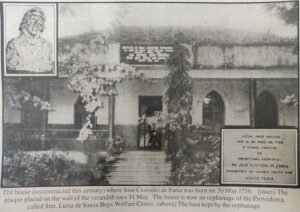 old city of Goa.
No bonds linked them ever since. The father and the son stayed a few years at their friends in Candolim – the Pintos of the Conspiracy fame – and at Colvale too. On 21 February 1771, four years after being ordained a priest, Caetano Vitorino left for Lisbon, en route for Rome, to continue his priestly studies. He had similar intentions for his son. Their social circle in Goa and particularly a letter of recommendation they carried for the nuncio in Lisbon, Mgr. Inocencio Conti, won them access to the royal court. Moreover, the reigning monarch, Dom José I, and his prime minister, the Marquis of Pombal, were favourably disposed towards the Goans, whom they strongly recommended for civil, military and ecclesiastical positions at home.
Student in Rome
Thus José Custódio was awarded a scholarship to study in Rome. The father returned to Lisbon in 1777 on attaining a doctorate to further his objective of objective of being appointed the bishop of Goa. His great disappointment and frustration on this count determined much of what followed in his life and his son’s too.
José Custódio stayed on and was ordained on 12 March 1780. At 24 he completed his doctoral thesis titled Theologicae Propositiones: De Existentia Dei, Deo Uno et Divina Revelatione (Theological Propositions on the Existence of God, One God and Divine Revelation) and joined his father in Lisbon.
The duo were good friends but a different purpose animated them. Caetano Vitorino, the more political minded and diplomatic of the two, was fully immersed in matters Goan. He was a sort of self-appointed protector of and influential reference for the Goan community. The Court had been impressed by the fact that, though immensely influential at the highest levels of the kingdom’s administration, he had never asked favours for himself, though it was known that his personal finances were far from bright. But then, intelligence reports began to pin him down as the mastermind and coordinator in Lisbon of a political revolt at home in 1787. As soon as news of this reached Lisbon, they hunted for the duo and their good friends, clerics and laymen.
Meanwhile, all except Fr. Caetano Vitorino had fled to Paris, reportedly to meet and discuss with their envoys of Tipu Sultan, who proposed to be on the French side in their ascendancy against the British in India, but nothing was confirmed in this respect. Others believe that simpler reasons motivated Fr. José Custódio’s sudden departure – that he was attracted by the intellectual climate of France. His father did, however, stay back, still persevering in his designs and probably even overestimating his influence with the high officialdom. He was then put under house arrest in the Carmelite convent where he gave his priestly assistance, and probably died in 1799.
In Paris
Nothing is known of Fr. José Custódio’s activities in the French capital except that he was accused, in 1792, of being a gambler and frequenter of the Palais-Royale. He was acquitted, or at least no action was taken against him by the police. Three years later, on 5 October 1795, he led a battalion of revolutionaries against the National Convention. This political stand made him popular with the supporters of the Directoire and won him the friendship of the Marquis de Chastenet de Puységur.
The latter relationship was decisive. The Marquis had been a disciple of Mesmer whose quackish furrows into ‘animal magnetism’ and tall claims of cures had initially won him the acclaim of high Parisian society. But, in 1785, his exit was shameful. The Marquis, on the other hand, was an honest, well-meaning and cultured person, who took over from where Mesmer had left. Dr Egas Moniz, the Portuguese Nobel Prize Winner and biographer of Fr. José Custódio de Faria, speculates that he acquired knowledge of magnetism in Paris after he struck up an acquaintance with the Marquis.
The first news of Fr. Faria’s activity as a magnetizer is of the year 1802, in the memoirs of Chateaubriand (published in 1843), who referred to his experiments in derogatory terms. He had dined with Fr. Faria at the house of the Marchionesse of Custine. Here, Fr. Faria reportedly declared that he could kill a canary by magnetizing it. However, when the magnetizer was put to the test, he failed, which led Chateaubriand to conclude: ‘O Christian, my presence itself will be enough to make the tripod ineffective!’ Chateaubriand was a devout Catholic. He had strong reservations against magnetism – because of the Church’s attitude of suspicion towards it. But what is more is that Fr. José Custódio de Faria was a Catholic, no less!
Fr. José Custódio continued his research into the subject up to the year 1811, when he was appointed professor of Philosophy at the Academy of Marseilles. The Imperial Almanac of 1811 records that he lived there a year and was elected member of a medical society. Since he had no medical qualifications, the membership can only be attributed to his skills as a magnetizer. But for some mysterious reason, he was transferred, in fact, demoted, to the post of auxiliary professor at the Academy of Nimes. He felt slighted and frustrated and, unaccustomed as he was to life in a small city like Nimes, he returned to Paris, in 1813, in search of greener pastures. Unattached to any institution, he initiated his course in magnetism on 11 August 1813, 49, Rue de Clichy.
Sessions
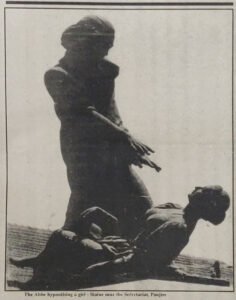
The sessions were held every Thursday, on an admission fee of five francs only. He began with a lecture in halting French. The audience, which consisted largely of women, paid scant attention to this part of the session; their eyes were set on what was to follow – his experiments to substantiate his theory.
Contrary to the claims made by Mesmer, the he could control the body fluids of his patients and rectify their course through special methods invented by him, Fr. José Custódio very humbly put forth that not all individuals could be hypnotised, and that the degree of response to his hypnotic powers necessarily varied from person to person. He was the first to establish that hypnotism was a science of suggestion.
Fr. Faria’s method consisted of a series of well-reasoned and effective actions: he got the patient to sit comfortably and, through concentration, to relax, imagining that they were going to sleep. When the patient was ‘tranquil’, he gave the command, ‘Sleep!’ and, if necessary, repeated it, with a certain degree of urgency, three or four times. If he failed, he would either sportingly give up or try other methods.
The sessions became the rage of the town. There were detractors, critics and skeptics, no doubt. Once, a journalist attended his session and then unjustly criticised and ridiculed the priest in the press. At another session, a leading stage actor, Potier, offered himself for his experiments. He feigned to be in a trance and suddenly rose to say, ‘Ah, Abbé! If you magnetize others as well as you magnetized me, you don’t seem to be doing much.’
Fr. José Custódio put up very well with all such betrayals. He also withstood quite stoically criticism from the clergy and Rome, who then viewed his experiments with suspicion always on the look-out for diabolical influences therein. But the priest always expressed respect for the Church and a firm desire to stay within the Catholic fold. ‘Un esprit supérieur,’ as his disciple Gen. Noizet said of him, he wished to convince the Church that his experiments were fully within the natural realm and that there was no magic or witchcraft involved.
Thus, Fr. Faria took everything in its stride. Only once did he break down, when at Potier’s request the playwright Jules Verne put up a play, on 5 September 1816, the Variétés, titled La Magnétismomanie, ridiculing the Goan priest.
Sad end
The time was now ripe for Fr. Faria to stop his activities. He retired soon thereafter, rendering priestly services in exchange for boarding and lodging.
During the last years of his life, he decided to organize his material in book form. It was an ambitious project in four volumes, of which only the first one is known to have appeared. It is his magnum opus is titled De la cause du sommeil lucide ou Étude de la nature de l’homme (On the Cause of Lucid Sleep or Study on the Nature of Man). In it he referred to the shameful play:
‘With regard to Magnétismomanie, I cannot ask which laws permit the modern Terence to expose an unknown foreigner to public ridicule. I presume that even the savage would be ashamed to insult his kind, which has nothing in common with actors and the theatre.
‘Far from me the idea to disturb public pleasures: But I might have added to Magnétismomanie a new scene – an extremely pungent one – had my condition not prevented me from doing so, and had my own aversion for such amusements not kept me away from playhouses.’
According to one biographer, by a strange coincidence, the day of his death, also marks the release of his book. His famous words, ‘There are evils that sometimes do good to those who discern their utility,’ might have very well served as his epitaph – if only he had the money for a decent burial. He died at the age of 63, unsung as he was born. A life full of ironies, for born of a rich family he died poor; born of parents who were in love, they separated after his birth; a man with original contributions to posterity, he died with no godfathers to promote his name.
(Herald Illustrated Review, Panjim, Goa. Vol. 95, No. 30, February 1-15 1995. Slightly updated version)