Procissões da Santa Paixão em Pangim
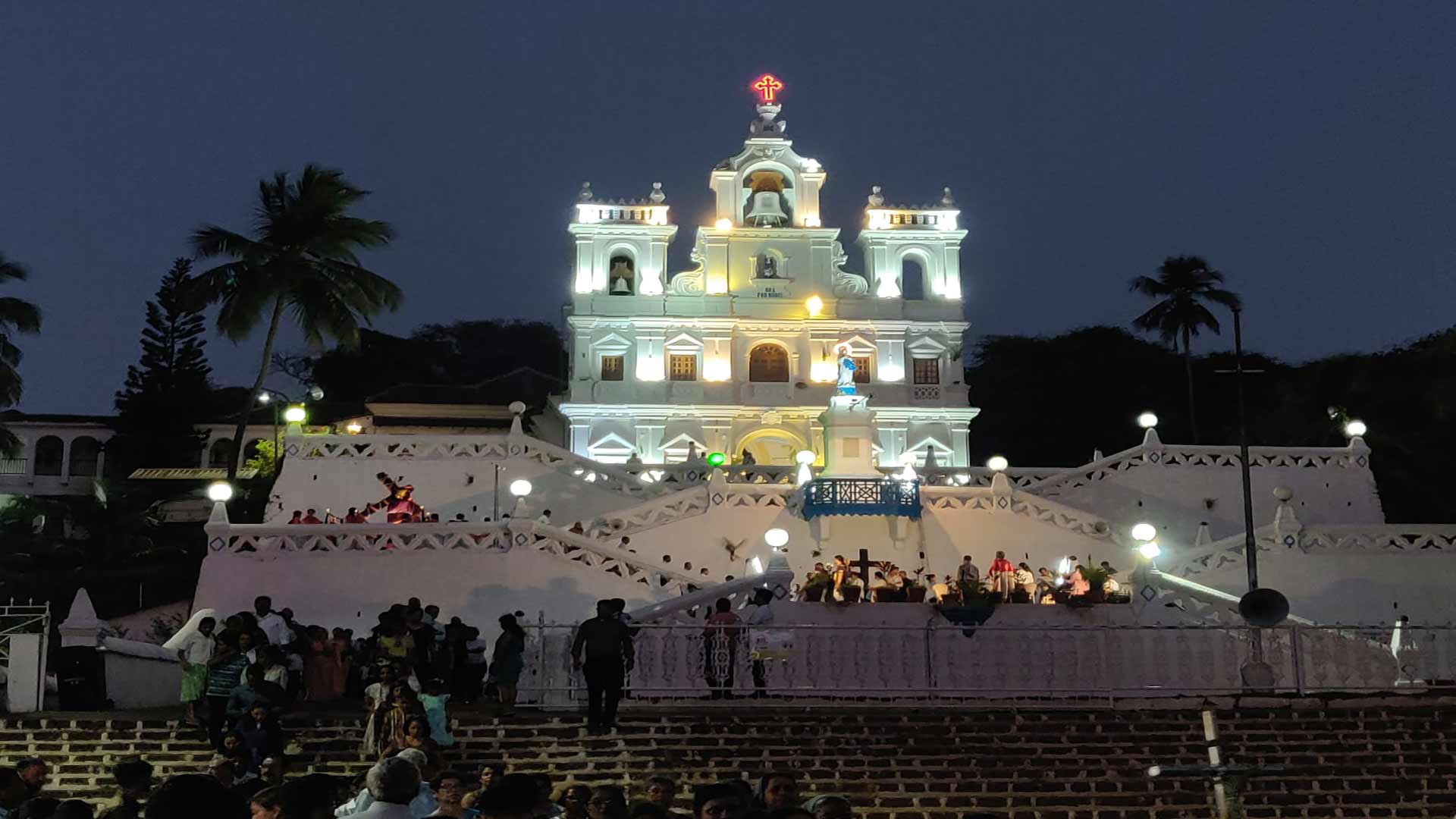
Na Igreja Matriz da Imaculada Conceição, em Pangim, o sexto domingo da Quaresma começa com um tom festivo. É o Domingo de Ramos, que comemora a entrada triunfal de Jesus em Jerusalém.
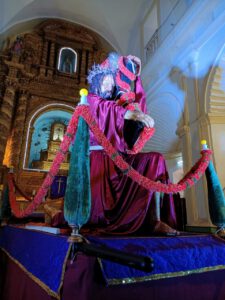
Após as missas da manhã, porém, há uma visível mudança no clima, especialmente com a revelação do quadro no altar-mor: uma monumental estátua de Cristo a suportar a Cruz. Daí a designação alternativa do dia, ou da sua segunda metade: Domingo da Paixão.
Domingo da Paixão
Na tarde do Domingo da Paixão vai uma procissão solene que começa e termina na icónica igreja. Este é o ponto alto dos Santos Passos, realizados nos primeiros cinco domingos da Quaresma, destacando alguns dos momentos mais intensos da Paixão de Cristo que conduzem ao Calvário: a agonia no Jardim do Getsémani, a prisão de Jesus, a flagelação em torno da coluna, a coroação de espinhos e a condenação por Pôncio Pilatos.1 Nem sempre as igrejas em Goa têm o mesmo arranjo.2
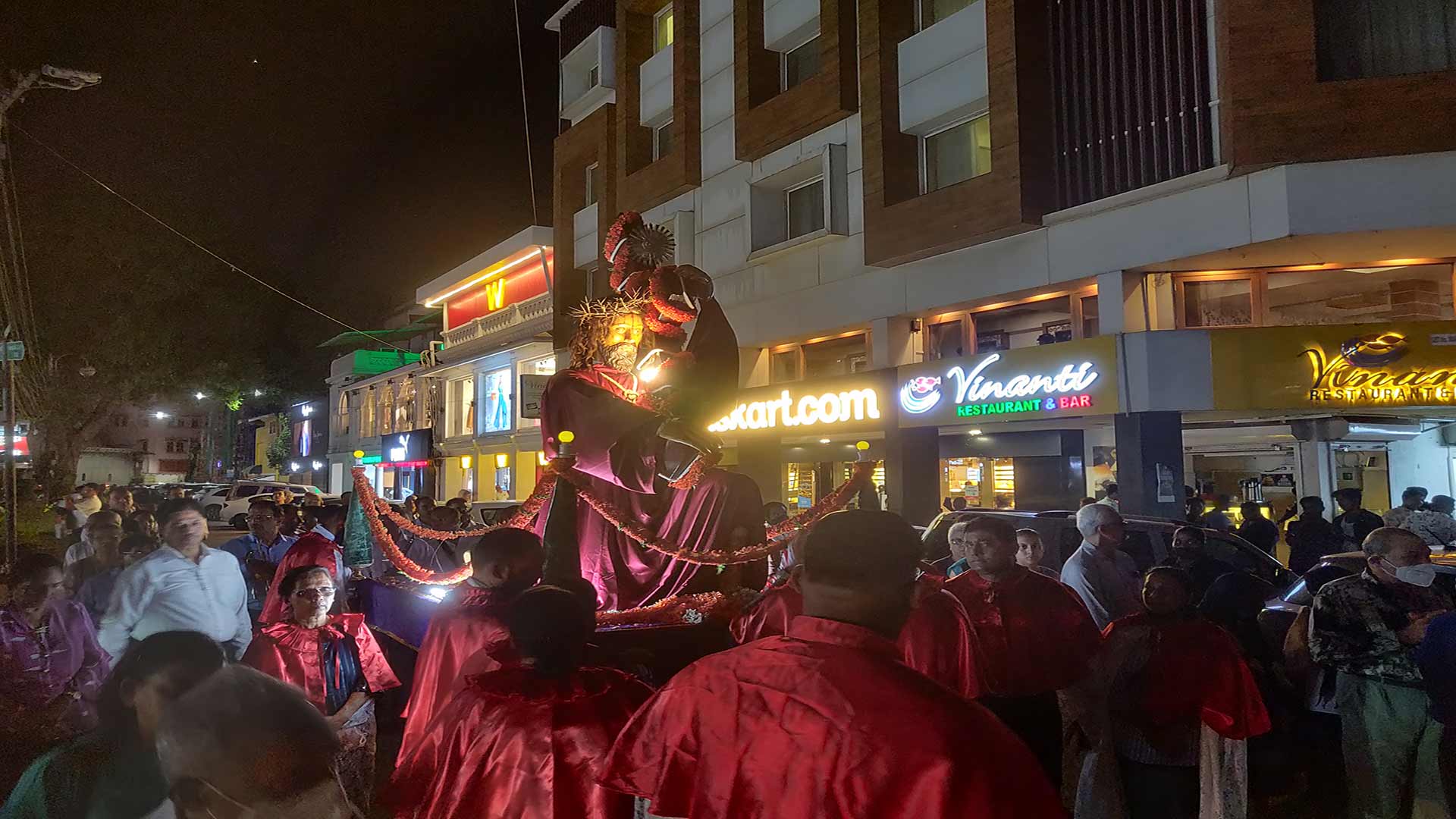
O Domingo da Paixão marca o início da Semana Santa. A cor predominante é o roxo; os altares ficam vazios e sem decorações florais. Após a missa da tarde, uma procissão conhecida como Cruz às costas — com o referido cenário de Jesus carregando a Cruz — percorre primeiro estes espaços públicos da capital: o largo da igreja; um trecho da Rua 18 de Junho e da Pissurlencar, e o Azad Maidan (antigo Largo Afonso de Albuquerque).
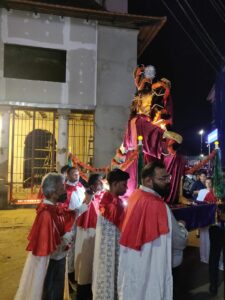
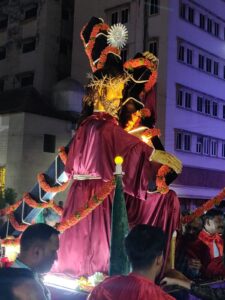
Os confrades vestidos de opa e murça (capa vermelha e branca) carregam a estátua em conjunto, e tem-se a impressão de que ela está a flutuar por conta própria (Figura 1). No passado, uma banda de metais acompanhava a procissão, mas actualmente um coro canta de um patamar intermediário da escadaria em ziguezague da igreja. Ouvem-se cânticos e orações ao longo do percurso por meio de altifalantes. Os fiéis passam em fila, recitando os cinco Mistérios Dolorosos do Rosário até ao final da procissão.
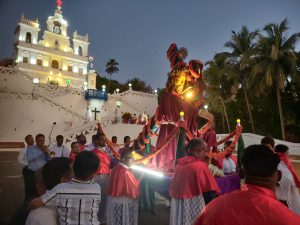
Figura 1. Cruz às costas (Foto: Óscar de Noronha)
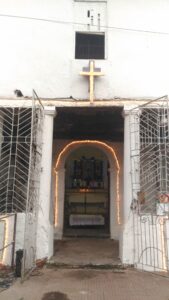
Mais de dez descansos (paragens) marcam o circuito. Nesses pontos, os fiéis acorrem para beijar a estátua. Uma pausa importante ocorre na Capela da Conceição. Construída em 1823, era uma capela privada anexa ao palacete de Dom Lourenço de Noronha, um nobre português. A capela foi legada às Confrarias da Igreja de Pangim e está em reparação desde 2019.
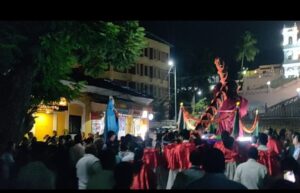
A procissão prossegue então pelas ruas Mahatma Gandhi e Dr. Domingos Roque de Sousa, passando pelo Jardim Garcia de Orta, até ao largo da igreja. Ao pé da escadaria, Jesus encontra sua Mãe, Maria (Figura 2). Entristecida pelo seu Divino Filho ter sido tão injustamente acusado e obrigado a carregar a cruz até à morte, ela acompanha-o nos seus últimos passos, como fez no Gólgota há dois mil anos.
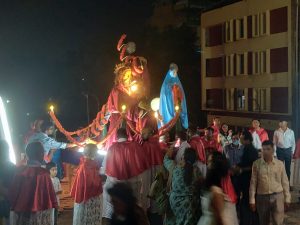
Figura 2. Jesus encontra sua Mãe Maria (Foto: Óscar de Noronha)
Logo depois, as duas estátuas param no patamar intermediário, em frente a uma grande cruz incrustada na parede. No nível superior, a partir de um varandim a modo de púlpito, uma menina desenrola um Véu de Verónica enquanto canta a narrativa tradicional sobre o encontro da lendária mulher com Jesus. Conforme registado na quarta estação da Via Crucis, Verónica, comovida ao ver Jesus a carregar a Cruz, enxugou a sua testa com o lenço, encontrando uma impressão duradoura do seu rosto sagrado no pano.
Assim termina o Domingo da Paixão e, na tarde da Quinta-feira Santa, começam os preparativos para o Tríduo Sagrado. A missa vespertina, com o tradicional lava-pés, celebra a instituição da Eucaristia e do sacerdócio e a proclamação do mandamento do amor. Não há procissão pública.
Sexta-feira Santa
A estrutura da procissão da Sexta-feira Santa assemelha-se à do Domingo da Paixão, ressalvadas as devidas diferenças.
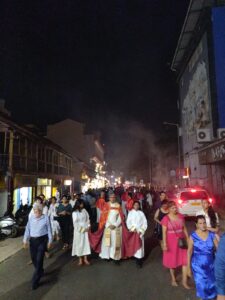
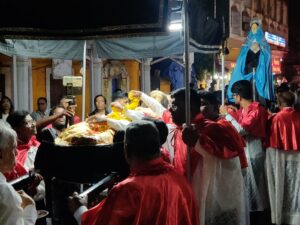
O comovente cenário da Crucifixão começa no altar-mor às 3,00 h da tarde. Nessa hora, curiosamente, o céu costuma estar nublado e o clima sombrio. A liturgia da Palavra e a Eucaristia continuam até cerca das 17,30 h. A seguir, a procissão parte com a figura recostada do Senhor Morto, maior que o tamanho natural, colocada num andor (Figura 3) e acompanhada pela imagem de Nossa Senhora.
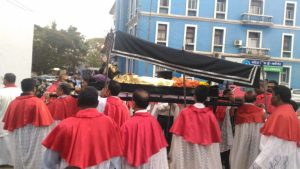
Figura 3. Procissão do Senhor Morto (Foto: Óscar de Noronha)
Desta feita, os fiéis vestem trajes fúnebres, os quais antigamente eram trajes formais. Em vez do sino Sanctus, ouve-se a matraca ou chocalho de madeira, em cada paragem da procissão.
Uma diferença importante entre a procissão do Domingo da Paixão e a da Sexta-Feira Santa está no desfecho deste evento barroco: um padre profere o Sermão da Soledade de Maria a partir do mesmo varandim que funciona como púlpito. O pregador exalta as virtudes de Maria e destaca as suas disposições interiores. Dantes, a retórica desempenhava um papel crucial nessas ocasiões, ajudando a envolver totalmente a congregação. Hoje em dia, observa-se um número limitado de fiéis ouvintes, que se distraem facilmente, sobretudo com o ruído dos veículos que, além disso, retira a solenidade do ambiente.
Espectáculo comovente
Uma semelhança marcante entre as procissões é que ambas são assistidas com admiração por pessoas de outras religiões, incluindo polícias que ficam em posição de sentido e saúdam, principalmente, o Senhor Morto.
Em ambas as ocasiões, as residências ao longo do percurso enfeitam-se com luzes decorativas, velas ou lamparinas, em homenagem a Nosso Senhor. O mesmo sucede com alguns estabelecimentos não-cristãos que, sendo dia de serviço, permanecem abertos. O caso dos Caculó e dos Neurencar, duas famílias hindus na Rua Pissurlencar, é particularmente interessante; eles tradicionalmente oferecem guirlandas de xênvtim (crisântemo) ou de abolim (crossandra).
Em ambos os dias, dependendo do número de participantes, a marcha piedosa, com um quilómetro de extensão, e as cerimónias relacionadas duram entre 75 e 90 minutos. As estátuas regressam à igreja para os rituais finais e veneração. Às 8 horas da noite, encerram-se os trabalhos!
Esses dois eventos processionais deixaram uma marca duradoura na minha mente. Foi assim quando a minha vida começou; assim é agora que sou um homem. E assim será quando eu envelhecer — pois essa tradição antiga é, sem dúvida, um dos espectáculos mais comoventes do calendário religioso e cultural da minha cidade, Pangim.
Publicado na Revista da Casa de Goa, Serie II, No. 39, marco-abril de 2026, pp 43-47
Notas: Veja-se também
https://www.oscardenoronha.com/2019/03/17/santos-passos-in-panjim/
https://www.oscardenoronha.com/2021/03/21/lenten-traditions-in-goa/
https://studio.youtube.com/video/XaVO6nY2ASQ/edit
https://www.youtube.com/watch?v=sXlnAoKU42M&t=17s

Holy Passion Processions in Panjim
At Panjim’s Church of the Immaculate Conception (Igreja Matriz or main parish church), the sixth Sunday of Lent begins on a festive note. This is Palm Sunday, which commemorates the triumphant entry of Jesus into Jerusalem.
However, after the morning Masses, there is a visible change in the mood, especially with the unveiling of the tableau in the chancel: a huge statue of Christ carrying the Cross. Hence, the alternative designation of the day, or of its second half: Passion Sunday.
Passion Sunday
The Passion Sunday evening features a solemn procession that begins and ends at the iconic church. This is the highpoint of the Santos Passos (‘Holy Steps’) held on the first five Sundays of Lent, highlighting some of the most intense moments of Christ’s Passion leading to Calvary: Agony in the Garden of Gethsemane, the Arrest of Jesus, the Flagellation at the Pillar, the Crowning with Thorns, and the Condemnation by Pontius Pilate (See my blogpost https://www.oscardenoronha.com/2019/03/17/santos-passos-in-panjim/ ). Not all churches in Goa necessarily have the same set-up (See https://www.oscardenoronha.com/2021/03/21/lenten-traditions-in-goa/ ).
Passion Sunday signals the beginning of Holy Week. The predominant colour is purple; the altars are bare, and flower arrangements absent. After the evening Mass, a procession called Cruz às Costas—the said tableau of Jesus carrying the Cross—first wends its way through these public spaces of the capital: the Church square; a section of 18 June and Pissurlencar Streets, and Azad Maidan (formerly called Afonso de Albuquerque Square).

Confrades (Church confraternity members) wearing opa e murça (red and white cape) carry the statue concertedly, and one gets the impression that it is floating on its own power (Figure 1). In the past, a brass band would follow, but nowadays, a choir sings from an intermediate landing of the church’s zigzag stairway. Singing and prayers are heard throughout the route via funnel loudspeakers. The faithful file past, reciting the five Sorrowful Mysteries of the Rosary until the end of the procession.
Over ten descansos (halts) mark the circuit. At those points the faithful flock to kiss the statue. There is a major halt at the Capela da Conceição (Chapel of the Immaculate Conception). Built in 1823, it was once a private chapel attached to the mansion of Dom Lourenço de Noronha, a Portuguese nobleman. The chapel was bequeathed to the Confrarias (Confraternities) of Panjim Church and has been under repair since 2019.
The cavalcade then proceeds via Mahatma Gandhi and Dr Domingos Roque de Sousa Streets, past the Garcia de Orta Garden, up to the church square. At the foot of the stairway, Jesus meets His Mother, Mary. Sorrowing over her Divine Son so unjustly accused and made to carry the Cross to His death, she accompanies him on his last legs, as she did at Golgotha two thousand years ago.
Soon thereafter, the two statues halt on the intermediate landing in front of a large wall cross. A level higher, from a narrow, pulpit-like balcony, a little girl unrolls a Veil of Veronica while she sings the traditional narrative about the legendary woman’s meeting with Jesus. As recorded in the fourth station of the Via Crucis, Veronica, moved by the sight of Jesus carrying the Cross, wiped his brow with her handkerchief only to find a lasting imprint of His holy face on the cloth.
Thus ends Passion Sunday, and on the evening of Maundy Thursday preparations get underway for the Holy Triduum. The evening Mass, with the traditional washing of the feet, marks the institution of the Eucharist and the priesthood and the proclamation of the commandment of love. No public procession is held.
Good Friday
On Good Friday, the processional arrangement is similar that of Passion Sunday, except for a few necessary differences.
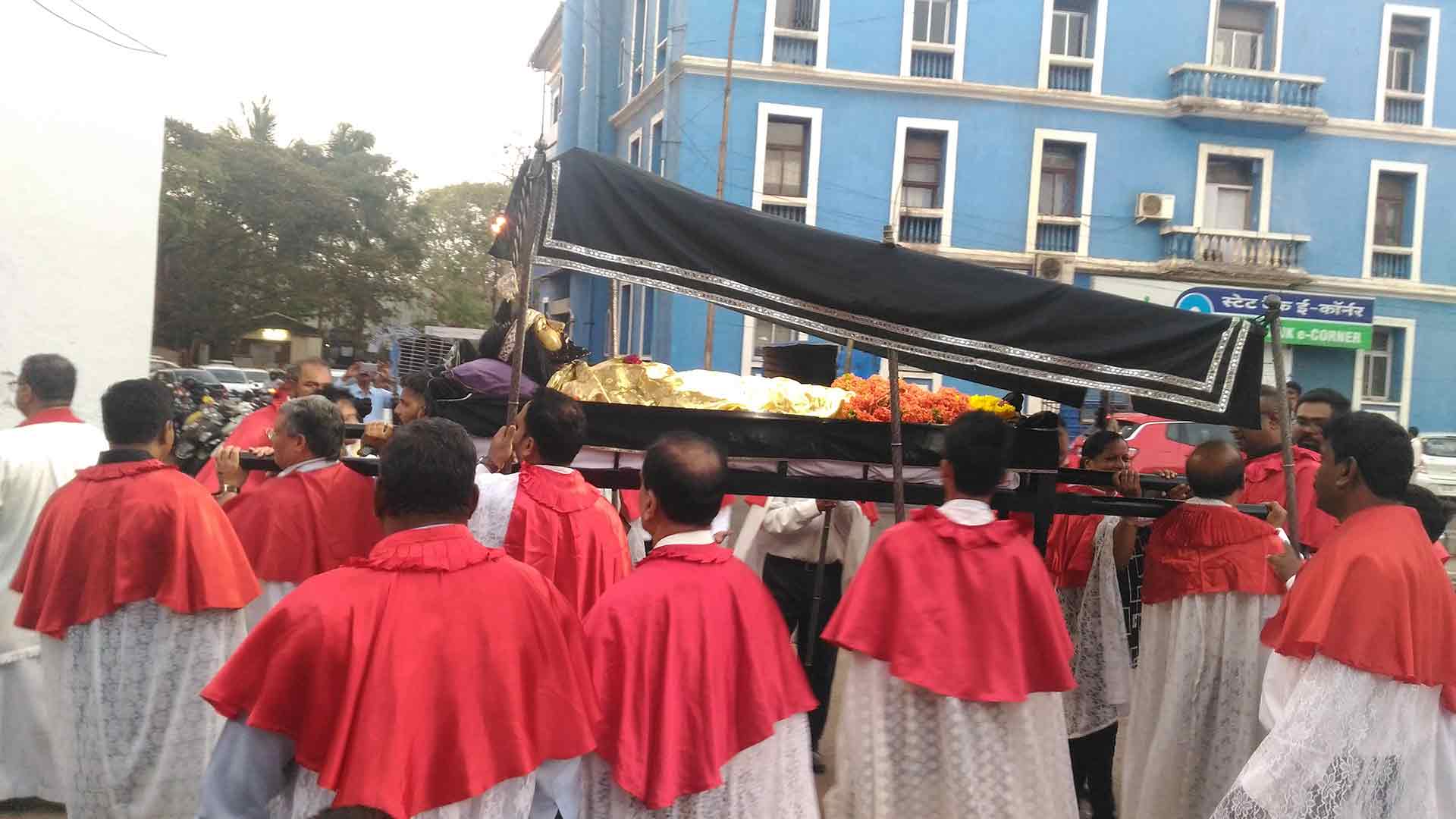
The poignant Crucifixion tableau opens in the chancel at 3 o’clock in the afternoon. Interestingly, the sky is usually cloudy and the mood is sombre by then. The liturgy of the Word and the Eucharist continue until about half past five. Then, a procession of a recumbent larger-than-life-size statue of Senhor Morto (The Departed Lord) placed on an andor (black canopied wooden platform) starts off, with the statue of Our Lady in trail.
On this day, the faithful are in funereal attire, which once was de rigueur. Instead of the Sanctus bell, one hears the matraca or wooden rattle, at every halt in the procession.
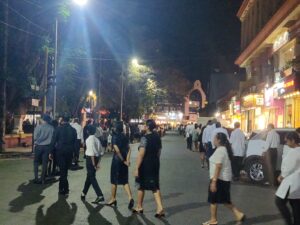
A major difference between the Passion Sunday and the Good Friday procession lies at the end of this baroque event, when a priest delivers a Sermão da Soledade de Maria (Sermon on the Solitude of Mary) from the same pulpit-like balcony. The preacher extols Mary’s virtues and highlights her interior disposition. Previously, rhetoric played a crucial role on such occasions, helping to fully engage the congregation. Nowadays, one finds a limited number of faithful, who are easily distracted, not least by traffic noise that further detracts from the solemn ambience.
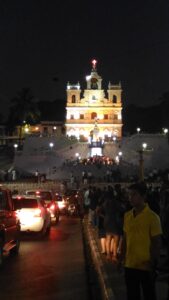
Moving spectacle
A striking similarity between the processions is that both are watched in awe by people of other religions, including policemen who stand at attention and especially salute the Departed Lord.
On both occasions, residences along the route set up decorative lights, candles, or oil lamps in homage to Our Lord. Some non-Christian establishments that are open, as it is a working day, do likewise. The case of the Caculos and the Neurencars, two Hindu homes on Pissurlencar Street, is particularly interesting; they traditionally offer xênvtim (chrysanthemum) or abolim (crossandra) garlands.
On both days, depending on the number of attendees, the pious, kilometre-long march and related ceremonies take between 75 and 90 minutes. The statues return to the church for the concluding rites and veneration. By 8 o’clock, they call it a night!
These two processional events have left a lasting imprint on my mind. So was it when my life began; so is it now that I am a man. And so be it when I grow old—for this ancient tradition is undoubtedly one of the most moving spectacles in the religious and cultural calendar of my city, Panjim.
Also published in Revista da Casa de Goa, Series II, No. 39, March-April 2026, pp 43-47;
Zest magazine, The Navhind Times, Panjim, 27 March 2026, p. 1
Requests:
1- In the comments section below, do share snippets of similar traditions in your village or city, and document them whenever possible.
2 - Do watch my video titled "Passion Sunday Procession in Panjim", on http://www.youtube.com/@oscardenoronha
Good Friday Procession in Panjim
The 3 o’clock, Good Friday service at the city church of the Immaculate Conception comprises a poignant Crucifixion tableau.
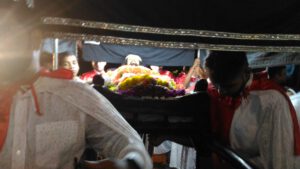
Soon thereafter, a procession of Senhor Morto (Dead Lord) on an andor (black canopied wooden platform carrying a life-size statue of Our Lord who died on the Cross) starts off, with a statue of Our Lady in trail. It wends its way through the main thoroughfares (the church square, a section of 18th June, Pissurlencar, past Azad Maidan), making a major halt to pray at the chapel formerly attached to the mansion of a Portuguese noble family. The cavalcade then proceeds via M. G. Road and Dr D. R. de Sousa, past the Garcia de Orta Garden, and up the church stairway.
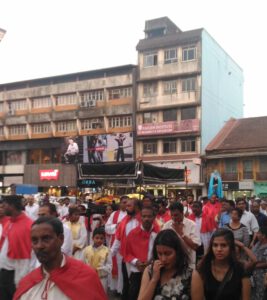
The pious march takes approximately 90 minutes. It is animated by five decades of the Marian rosary recited over speakers fitted at several points; and by Lenten hymns sung by a choir to the accompaniment of a brass band. The circuit is marked by over ten descansos (halts). At these points, penitents, all of them de rigueur, in funereal attire, flock to the two statues. Members of other religious faiths also pay their respects; many watch in awe or stand at attention (I noticed a policeman saluting).
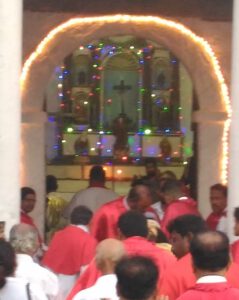
One such halt is at a quaint chapel traditionally called 'Capela de Dom Lourenço', located behind what is now the iconic Hotel Mandovi. In times past, the chapel was part of the manor belonging to Dom Lourenço de Noronha, a Portuguese nobleman, who had acquired a large estate in the then incipient city centre. After the palatial mansion was razed, the chapel was handed over to the care and possession of the city church. Alas, the venerable structure is in a state of disrepair.
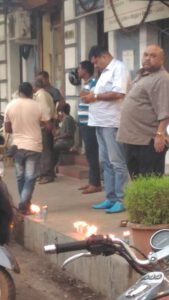
On the said route, two Hindu families (Caculó and Neurencar) traditionally offer garlands. Businesses brighten up their establishments, or simply light candles and burn incense on the adjoining pavements.
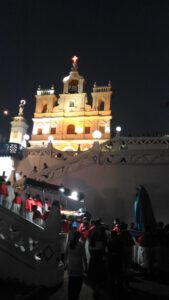
In a coda to the baroque event is a sermon (Sermão da Soledade de Maria) at a stair landing: here, from a balcony that serves as a makeshift pulpit, a priest extols the virtues of Mary and highlights her present solitude. The congregation listens in silence even while vehicle noises spoil the ambience.
The statues return to the church for final veneration. By 8 o’clock, they call it a night!