A Road Well Taken
Selecting the right path, both literally and figuratively, is the central theme of American poet Robert Frost’s ‘The Road Not Taken’. The poem was prompted by the continual state of indecision faced by an English writer-friend of his. When the two went for walks, his friend always found it difficult to choose a route, and even after all that fuss was over, he sighed over the opportunities missed on the other route.
The poem popped into my mind as I was going through the Mass readings. We have Isaiah (6:1-2A, 3-8), Paul (1 Cor 15:1-11) and Peter (Lk 5:1-11), three Biblical heavyweights. Like Jeremiah last Sunday, they too faltered at first, then made a leap of faith. They received their calls quite differently but, animated by the love of God, they had the same goal in mind. And unlike the man in the poem, they never regretted the road they had taken. In fact, they were convinced, they persevered under trials, and received the crown of life.
Isaiah receives his prophetic call at the feast of Atonement. In the temple, he had visions of the heavenly court. He did not get to see God face to face; he only glimpsed the train of his garment and heard the quake and the smoke – signs of God’s presence. As he heard the angels sing the Sanctus (the same that we now hear at Mass) he began to feel anxious about his sinful state vis-à-vis God’s presence. He anticipated death but instead was healed by the touch of a burning coal. Fired thus with God’s spirit, he gave his fiat: ‘Here I am! Send me!’
Isaiah was ready to go as God’s messenger, and so was Saul after he became Paul. Initially a persecutor of the Christians, Paul’s dramatic encounter with Jesus on the high road to Damascus changed it all. He offered himself without reservation to God’s service. He undertook four missionary journeys and came to be called ‘Apostle of the Gentiles’. And as there were misgivings about Jesus’ death and resurrection, Paul proclaimed it as an undeniable fact and, for him, a life-changing experience. About the Resurrection, which is at the heart of the Christian message, Paul said emphatically that, without it, ‘our faith is futile’.
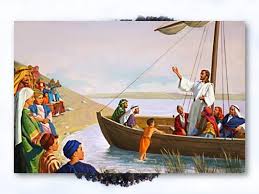
Whereas Isaiah was timid, and Paul who was conceited became humble after his personal experience of God, Simon Peter for his part was a rustic character. Jesus, however, did not look at his intellect but at his heart. A fisherman and unlettered though he was, Jesus made of him a fisher of men. Peter eventually became greater than all men of letters put together, schooled as he was in the knowledge and the love of God. He was in awe of Jesus, and on hearing His soothing words – ‘Do not be afraid. You will catch people from now on’ – Peter and his fellow fishermen James and John left everything and followed Him.
You and I, who are called to live out our baptismal vocation of priest, prophet and king, where do we stand? Do we believe that we should leave everything and follow Him? Or, do we, like the poet, see two paths, unsure which to choose?
Really speaking, Christians have only one path before them: to be messengers of God’s salvation and grace by the apostolate of presence. We are called to be the light of the world and the salt of the earth, such that the temporal is soaked in the Christian spirit. Indeed, we must not let ourselves be blinded by the city lights; we must not be lured by ideologies that lead us astray from the path of truth and justice; we must rather be committed to the only life-giver, Jesus Christ. He is the Way, the Truth and the Life. He shows us the road to Eternal Life. This cannot but be a road well taken.

The Splendour of our Vocation
Today we have a feast of scriptural texts about our prophetic vocation: Jer. I, 4-5, 17-19; I Cor. 12, 31-13 13; Lk 4, 21-30.
Years ago, I froze in my tracks when I heard God’s words to Jeremiah: ‘Even before I formed you in the womb, I have known you; even before you were born, I had set you apart, and appointed you a prophet to the nations.’ There is, undeniably, a rare touch of intimacy here that makes us feel special; but do those words also place a heavy responsibility on our shoulders, holding us accountable for our role as prophets?
On the other hand, without that bolt from the blue, wouldn’t we end up becoming complacent, lukewarm, mediocre? When God’s voice resounds in our minds and hearts, we are in awe of His majesty and mystery. His declarations also provide the shot in the arm that we so badly need, timid and weak as we are, and at risk, too, like Jeremiah was. God’s promise, then, to make of us ‘a fortified city, a pillar of iron with walls of bronze…’ feels so good and changes everything.
There is no denying that without aid from above, we are nothing. Notice the distressing experiences Jesus underwent in his hometown Nazareth. At first, ‘all agreed with Him and were lost in wonder, while He kept on speaking of the grace of God.’ They just stopped short of recognising His divine origin. And no sooner had they heard hard truths proceeding from the mouth of the Son of God, they became indignant and were even ready to throw Him down the cliff.
That’s a huge eyeopener; the nature of the public ministry and the ways of the world can indeed be baffling. Yet, we have to keep going; we have nothing better to do than what God has whispered in our ears. He expects no superhuman effort, nor should we expect to achieve success as the world looks at it; it just suffices to exercise our apostolate where we are planted. The only ammunition we need to carry is Love. No language, no prophecy, no knowledge, nothing can get round the devious ways of the world as love can.
St Paul’s ode to love is one of the most sublime of Christian texts and Jeremiah’s testimony one of the most impressive as regards the Christian vocation. Interestingly, they are both quoted at nuptial masses – for, after all, marriage is a very special vocation! It is no doubt fraught with risk and challenges, but then, very few are known to have given up before the miracle happened. Jesus too didn’t give up on His Bride, the Church. Why should we give up on the Church, our Mother, and all that she teaches us?