Today, the eighth Sunday of Easter, we celebrate Pentecost, or the fiftieth day after Easter. It marks the descent of the Holy Spirit upon the disciples.
The intimate connection between the two feasts will be lost on us if we do not look at its pre-Christian background.
In old Jewish tradition, the feast of Shavuot is the fiftieth day after the Pesach (Passover). This was held to commemorate the liberation of Jews from slavery in Egypt. On this occasion, many Jews from countries around the Mediterranean came on pilgrimage and stayed until the Shavuot. This was at first an agricultural feast (a thanksgiving for the first fruits of the wheat harvest) but later came to be related to the receiving of the Law by Moses on Mount Sinai.
On the other hand, a new tradition began when the Resurrection coincided with the day of Passover. In fact, the Resurrection replaced the Passover, precisely because by His death and resurrection, Jesus offered the world freedom from death and sin. Similarly, fifty days later, or say, coinciding with Shavuot, Jesus sent down the Holy Spirit upon His disciples. Thus was Shavuot christianised and called Pentecost, Greek for ‘fiftieth day’.
So much for the relation between the old and the new.
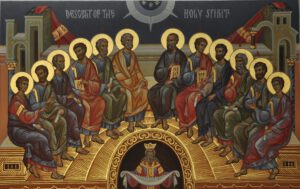
In the First Reading (Acts 2: 1-11), St. Luke describes the marvel of Pentecost. The disciples and others were gathered to celebrate Shavuot when there was the rush of a mighty wind, and tongues of fire came to rest on each of them. While the wind represents the breath of God blown into the disciples, the fire represents the courage and enthusiasm that filled the disciples.
In concrete terms, Pentecost is the foundation day of the Church. On this day, Jesus sent down the Holy Spirit to guide and inspire the disciples on their mission to preach the Gospel, just as He had promised them before he ascended to the Father. ‘As the Father has sent me, even so I send you,’ says today’s Gospel (Jn 20: 19-23), a longer form of which was read on the Second Sunday of Easter.
To effectively conduct missionary work, each member of the community received (and still receives) one or more gifts and charisms. There are seven gifts of the Holy Spirit: wisdom, understanding, counsel, fortitude, knowledge, piety, and fear of the Lord. Whereas gifts are ‘permanent dispositions which make man docile in following the promptings of the Holy Spirit’ (CCC 1830), given primarily for the purpose of personal sanctification, charisms (e.g., healing) are special gifts given for the common good, or the good of the Church (cf. CCC 798 ff).
Significantly, on the Birthday of the Church, there were people separated by languages, cultures, races and nations, all of them symbolised by the expatriate Jews present over there: they now formed the new People of God.
So, how important, really, is the Holy Spirit? St. Paul in the Second Reading (1 Cor. 12: 3-7, 12-13) says that ‘no one can say “Jesus is Lord” except through the Holy Spirit.’ It is the same Spirit that fills us with charisms and lets us serve, each according to our gift. While the charisms and services are varied, they are the same Lord. ‘To each is given the manifestation of the Spirit for the common good.’ This implies that our life must be dedicated to the truth that is God and to the service of the community.
This community is fundamentally the Church. Jesus is the tree or the body, and, correspondingly, we are the branches or the members. The Holy Spirit keeps us united and drinking of the same belief in the True God.
Can there be any doubt, then, that the Church is a divine rather than a human institution? The Holy Spirit gives her life. The same baptism of fire that the apostles received we too do receive through the Sacrament of Confirmation. The gift of tongue symbolises the fact that the Church goes out to the peoples of the world and adapts to their culture, of course, while doing what it has been called to do: that is, most clearly proclaiming Our Lord Jesus Christ and Him alone. That is how intimately the proclamation of the Gospel is related to Pentecost.
A hymn for Pentecost: https://youtu.be/5GrQJGQWfd8
Just read this article, Oscar, don’t know how I could have missed reading it sooner. Thank you. You have taken pains to explain the background of the feast of Pentecost. Also, the gifts and charisms of the Holy Spirit. We are so blessed. Your article has helped me turn to God in gratitude for sanctifying us with the Holy Spirit. You truly are a wonderful teacher who uses his charism to build up the Church.