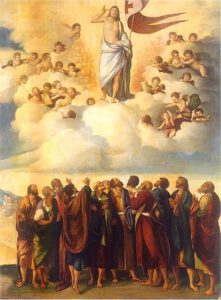
Even just the last two mysteries of the life of Jesus–the Resurrection and the Ascension–are sufficient to convince us that Jesus is God. The Resurrection shows that Jesus not only rose from the dead but also never died again. In his new, glorified body, Jesus revealed Himself at many locations over a significant forty-day period. Now, before the apostles’ very eyes, He ascended to His Father, and has been there ever since.
There is Scriptural testimony about the Ascension, because the eleven apostles (besides Mary and other disciples) were privy to the marvel. St Matthew (28: 16-20) and the Acts of the Apostles (1: 1-11) – both of which form the Gospel and the First Reading of today; St Mark (16: 15-20) and St Luke (24: 46-53) (earmarked for Years B and C of the liturgical year) talk about the Ascension.
Curiously, the Old Testament also refers to the Ascension in Psalm 68: 18, a reference that St Paul has used to great effect in the Second Reading (Eph 1: 17-23).
Several non-Christian historical sources also attest to Jesus’ historicity and to the Resurrection: Stoic philosopher Mara (c. 73 AD) in a letter to his son Sarapion, and the Greek-writing Jewish priest Flavius Josephus in his book Jewish Antiquities (c. 93 AD). The historical sources included writers hostile to Christianity: the influential Roman historian and senator Tacitus in his Annals (c. 116 AD); another Roman historian, Suetonius, in his Lives of the Twelve Caesars (c. 121 AD); and the Talmud (c. 400 AD), a collection of ancient Jewish laws.
Here is how The Catholic Encyclopaedia describes the glorious Ascension:
“Although the place of the Ascension is not distinctly stated, it would appear from the Acts that it was Mount Olivet, since after the Ascension the disciples are described as returning to Jerusalem from the mount that is called Olivet, which is near Jerusalem, within a Sabbath day’s journey. Tradition has consecrated this site as the Mount of Ascension and Christian piety has memorialized the event by erecting over the site a basilica. St Helena built the first memorial, which was destroyed by the Persians in 614, rebuilt in the eighth century, to be destroyed again, but rebuilt a second time by the crusaders. This the Moslems also destroyed, leaving only the octagonal structure which encloses the stone said to bear the imprint of the feet of Christ, that is now used as an oratory.
 “Not only is the fact of the Ascension related in the passages of Scripture cited above, but it is also elsewhere predicted and spoken of as an established fact. Thus, in John 6: 63 Christ asks the Jews: ‘If then you shall see the Son of Man ascend up where He was before?’ and in 20: 17, He says to Mary Magdalen: ‘Do not touch Me, for I am not yet ascended to My Father, but go to My brethren, and say to them: I ascend to My Father and to your Father, to My God and to your God.’ Again, in Ephesians 4: 8-10, and in Timothy 3: 16, the Ascension of Christ is spoken of as an accepted fact.
“The language used by the Evangelists to describe the Ascension must be interpreted according to usage. To say that He was taken up or that He ascended, does not necessarily imply that they locate heaven directly above the earth; no more than the words ‘sitteth on the right hand of God’ mean that this is His actual posture. In disappearing from their view ‘He was raised up and a cloud received Him out of their sight’ (Acts 1: 9), and entering into glory He dwells with the Father in the honour and power denoted by the Scripture phrase.”[1]
To positivists and rationalists who may mock the doctrine of the Ascension, the all-important twentieth-century author of Miracles[2], C. S. Lewis, states interestingly that after the Resurrection, it may have been that Jesus, “a being still in some mode, though not our mode, corporeal, withdrew at His own will from the Nature presented by our three dimensions and five senses, not necessarily into the non-sensuous and undimensioned but possibly into, or through, a world or worlds or super-sense and super-space. And He might choose to do it gradually. Who on earth knows what the spectators might see? If they say they saw a momentary movement along the vertical plane – then an indistinct mass – then nothing, who is to pronounce this improbable?”
In the universality of its observance, the Ascension ranks alongside Christmas, Easter, and the upcoming Pentecost. The Ascension completes a glorious cycle that began with the Incarnation; so, it makes perfect sense that Jesus, who deigned to come into the world, should, at the end of his mission of reconciling man to God, return to the bosom of the Father. His momentous last words on the occasion bear this out. For our part, we must bear Him witness throughout our pilgrim journey on earth, also gratefully acknowledging that, through His Ascension, Heaven and Earth have drawn near.
[1] Wynne, J. (1907). Ascension. In The Catholic Encyclopedia. New York: Robert Appleton Company. Retrieved May 20, 2023 from New Advent: http://www.newadvent.org/cathen/01767a.htm
[2] First published in 1947. Current edition, Fount: 2002.
Banner: https://rb.gy/bahmj
Very interesting read Oscar. Intriguing infact.