You may also watch this on my YouTube channel https://www.youtube.com/watch?v=XnLJlzixsA0&t=12s
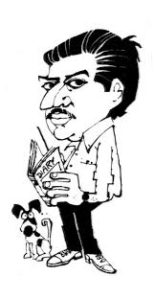
Óscar de Noronha (ON): Could you tell us something about what you worked on for your PhD, which is perhaps the first one on Mário de Miranda?
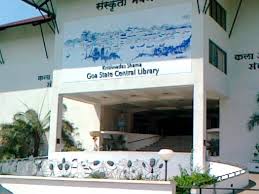
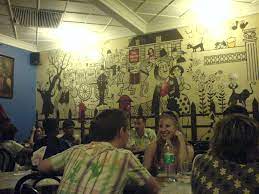
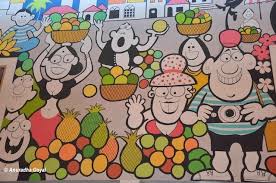
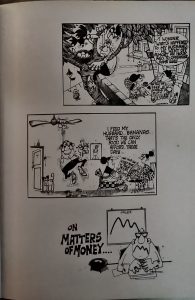
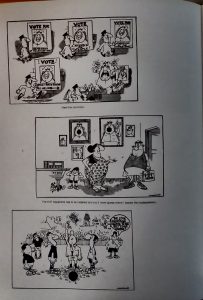
Prakruti Ramesh (PR): In my doctoral research, I tried to understand why some of the images created by the artist Mário Miranda were used, beginning in the 1980s and continuing till today, as a form of public art in Goa. You find Mario’s work displayed in government-controlled spaces like the airport, railway stations, municipal markets, the state library, and government cultural centres, but you also find his work in privately-controlled spaces, like restaurants, hotels, shopping malls, and institutes of higher learning. So, I was interested in why these pictures seem to appeal to diverse sets of people in Goa and what they communicate about the region’s history and present. What I did was basically to treat the images as a symptom of longer ranging historical processes pertaining both to Goan experiences of colonialism and to its experience of postcolonial development.
ON: Can Mário Miranda’s work be interpreted as sexist today?
PR: I would say that any form of creative expression can give rise to multiple interpretations. When social scientists like myself study cultural artifacts, what we try to do is to analyse them as evidence of social relations that prevail in a given place, at a given time. Mario’s artistic work offers clues both about the artist’s own disposition, that is, Mario’s individual biography, and about the broader political, economic, and social forces that shaped both the artist and his art.
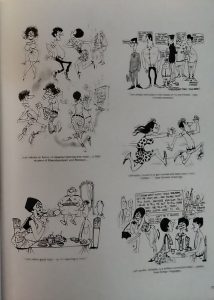
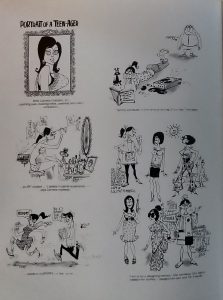
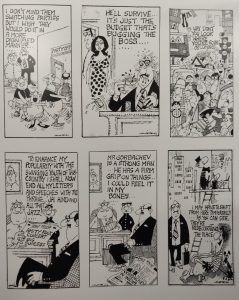
Mario’s work can certainly be analysed along the lines of gender, but they can also be analysed along other lines of stratification, like class or caste. In connection with gender, I think it’s true that quite a few of his images reproduce stereotypes about women, but these stereotypes need to be understood in relation to discourses and representations that did not originate in the mind of Mario Miranda but were in fact widely disseminated across a range of media in the twentieth century.
I think it is necessary to understand that Mario Miranda wasn’t producing his art in a vacuum. To some extent, he was following implicit or explicit directions given to him by his employers, and his employers were in turn influenced by their perception of the audience that they were catering to. They were also influenced by the professional culture of the print media at that time.
So, for me, the question is not really that of determining whether some of the pictures that Mario Miranda created were objectionable by today’s standards. What I find more interesting is, firstly, what do these images tell us about the time and place in which they were created, and secondly, what processes unfolding today have led to the retrieval of some of these images that he created, in the context of public art and city beautification. Which images are these and how do they relate to the rest of Mario’s work which does not get comparable attention.
And finally, every time an image from the past is extracted from its original context and used in the present, I think it’s interesting to ask how the image itself has changed and what new meanings are given to it by the circumstances of its display.
ON: Is there an anthropological dimension to Mário Miranda’s diaries?
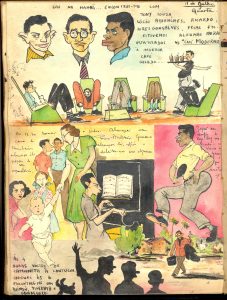
PR: I think the argument can certainly be made that the diaries of Mario Miranda which are currently accessible in English have an ethnographic component. Mario was documenting his day-to-day life with great regularity and with a high attention to detail. The form of these diaries is also extremely innovative because he blended written text with a variety of images, including cartoons, sketches, watercolour paintings, and even the occasional photograph.
But I personally would probably stop short of calling Mario an anthropologist, partly because he never claimed to be one, but also because an anthropologist’s craft includes a commitment to systematic and scientific documentation to the extent possible, of course, and Mario Miranda’s diaries are, clearly, highly subjective portrayals of his society.
But refraining from calling Mario an anthropologist does not in any way diminish the value of his work. The diaries remain very interesting historical resources with which to understand late-colonial Goa.
ON: Is Mário’s legacy yet to be recognised?
PR: One of the things that I noticed quite early into my research is that Mario Miranda has by and large been left out of recent scholarship about the history of cartooning and caricature in India. I’m not sure why this is so, but I suspect that it is because such scholarship has tended to focus on political cartoonists in India, and Mario tends to be grouped under the category of social cartoonists.
I hope that when my work is published it will correct for this omission in academic scholarship, but besides this lacuna which exists in the academic world, I think that even in Goa Mario’s artistic output tends to be very selectively celebrated. Some sections of his oeuvre have received extraordinary publicity while other sections remain neglected. And I think the selective nature of this memorial process is not a reflection of the quality of those sections of Mario’s oeuvre that are currently forgotten; rather, it reflects the values and priorities of those of us doing the remembering.
(First published in Revista da Casa de Goa, Series II, No. 40, May-June 2026, pp 42-45)