All three readings of today challenge us to understand our faith without beating about the bush; they are as forthright as forthright can be.
The First Reading (Is 56: 1, 6-7) is about being just and righteous if we are to be saved. None will be excluded from God’s salvific plan – neither the eunuchs (traditionally thought to be devoid of God’s favour) nor the foreign nations – provided they honour God’s law in letter and spirit. Israel, chosen to lead the nations to the True God, chose instead, disloyally and ungratefully, to worship Baal and other gods. To them, Isaiah made known in no uncertain terms that God would move on and invite peoples of all nations to the holy mountain, making them joyful in His house of prayer. This finally happened when the Good News of Salvation was proclaimed to the world by the Apostles.
Meanwhile, it may be noted that a ‘house of prayer for all peoples’ is by no means a free-for-all but rather a house where only the True God reigns. It is surely not an interfaith complex like, say, the Abrahamic Family House in Abu Dhabi, which includes a mosque, a church, and a synagogue. This attempt to put religions on par is evidently a gross violation of the First Commandment: ‘Thou shalt have no other gods before me.’ And alas, this is only the beginning. Other places of worship are on the horizon to complete the panorama of a pantheistic philosophy that will serve as the basis of a modern babel of religions.

Today’s Gospel (Mt 15: 21-28) provides an eloquent response. It is proof enough that the Divine Master wants his followers to zealously guard the Faith. Why did He apparently give the cold shoulder to the Canaanite woman who had asked Him to exorcise her daughter? By stating that He was sent ‘only to the lost of the house of Israel’, Jesus wishes to elicit a public demonstration of persistent, humble faith. It may be noted that the Canaanites, being idol worshippers, were traditionally regarded as enemies of God and a threat to God’s people.
Jesus added: ‘It is not fair to take the children’s bread and throw it to the dogs.’ This may sound insulting to modern ears, but Jesus, who always called a spade a spade, had no qualms about separating Light from Darkness. Our eternal salvation is at stake if we fail to acknowledge the difference.
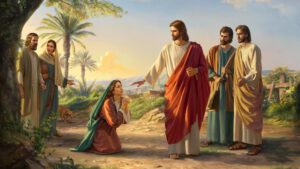
How, then, could a document be signed stating that the diversity of religions is willed by God? This relativises the uniqueness of faith in Jesus Christ. Now, if Jesus apparently discriminated against the Canaanite woman, it was not to demean her but to test her faith. So, when the plucky woman retorted, ‘Yes, Lord, yet even the dogs eat the crumbs that fall from their master’s table,’ Jesus relented and famously said, ‘O woman, great is your faith! Be it done for you as you desire.’ Her daughter was healed instantly.
Like the Canaanite woman, we often find people of other religions visiting Catholic places of worship with deep faith that Jesus can help them. Oh, the faith with which they come and ask for the gift of a child, a job, a spouse, resolution of conflicts, physical healings, peace of mind and heart; they approach Jesus with deep humility and acknowledge His power! And many return to thank Him for favours, graces and blessings received.
On the other hand, you and I, who are born Catholics, how often do we take our faith for granted, going on from day to day as though there were nothing marvellous happening in our lives and nothing to be eternally grateful for!
Couldn’t our unfaithfulness alone account for much of the confusion into which the world has plunged?
In the Second Reading (Rom. 11:13-15, 29-32), St Paul is sorry that his country has been unfaithful, but is also quick to point out that ‘the gifts and the call of God are irrevocable’. There is no doubt that Israel officially rejected the opportunity to proclaim the Good News and, meanwhile, God reached out to the rest of the world. However, the Apostle to the Gentiles is confident that Israel will ultimately turn to God. Israel’s current rejection of the Messiah is only temporary and serves a purpose in God’s larger plan.
That is the ultimate miracle we will witness through our faith and trust in God. Baal and Babel will be no more: Our Lord’s Sacred Heart and the Immaculate Heart of Mary will finally triumph, for it is said: ‘So shall my word be, which shall go forth from my mouth: it shall not return to me empty, but it shall do whatever I please, and shall prosper in the things for which I sent it.’ (Is. 55: 11) But we must rise to the occasion and stand as stewards of the cause.
Your articles are always thought-provoking. Thanks also for cautioning us. Your words sound a much-needed warning while simultaneously pointing to a time of hope and fulfilment.
Amen!