The Call of Mount Carmel
The Carmelite Order traces its origins to hermits who lived on Mount Carmel in Palestine, near the traditional site associated with the prophet Elijah, in the 12th century. These hermits, inspired by the example of Elijah and Elisha and their devotion to prayer and contemplation, later formed the Carmelite Order. On Mount Carmel, they erected a sanctuary dedicated to the Virgin Mary, at the same place where Elijah had seen the Cloud. They called themselves the Brothers of the Blessed Mary of Mount Carmel. They regarded Elijah as their spiritual founder.
Soon, many pilgrims began to join the Order, including St. Cyril (c. 1126 – c. 1235), St. Angelo (1185-1220), and St Simon Stock (c. 1165-1265). St Cyril, often referred to as Cyril of Constantinople, was a priest and a legendary figure in the Carmelite order. St. Angelo, also known as Angelus of Jerusalem, was a convert from Judaism; he became a Carmelite priest and was martyred.
In the twelfth century, there were many misunderstandings about the Hermits of Mount Carmel, particularly as they transitioned from their eremitical life on Mount Carmel to Europe. These challenges stemmed from adapting to new settlements, being present alongside other mendicant orders, and a lack of understanding about their specific ways of life.
St Simon Stock
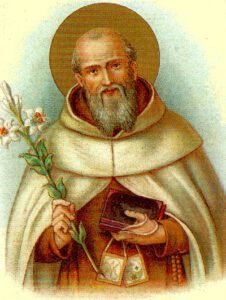
In the following century, Simon Stock, an English Carmelite, suffered a lot due to the opposition his Order faced in his country. On the night of 16 July 1251, at the height of his suffering, St Simon was praying hard to Our Lady; his fervent prayer was transformed into a marvellous hymn:
Flos Carmeli https://www.youtube.com/watch?v=EgxPDpnOl_M
Flower of Carmel,
Tall vine blossom laden;
Splendour of heaven,
Childbearing yet maiden.
None equals thee.
Mother so tender,
Who no man didst know,
On Carmel’s children
Thy favours bestow.
Star of the Sea.
Strong stem of Jesse,
Who bore one bright flower,
Be ever near us
And guard us each hour,
who serve thee here.
Purest of lilies,
That flowers among thorns,
Bring help to the true heart
That in weakness turns
and trusts in thee.
Strongest of armour,
We trust in thy might:
Under thy mantle,
Hard press’d in the fight,
we call to thee.
Our way uncertain,
Surrounded by foes,
Unfailing counsel
You give to those
who turn to thee.
O gentle Mother
Who in Carmel reigns,
Share with your servants
That gladness you gained
and now enjoy.
Hail, Gate of Heaven,
With glory now crowned,
Bring us to safety
Where thy Son is found,
true joy to see.
Amen. (Alleluia)
The Saint prayed and sang all night. At the first sign of dawn, Our Lady appeared to him, surrounded by the angels, dressed in the habit of the Carmel. She smiled and brought in her virginal hands the Scapular of the Order, with which she clothed the man of God, saying: ‘This is a privilege for you and all the Carmelites. Whoever dies wearing this scapular shall not fall into Hell.’
Of course, we cannot go by the false idea that the mere wearing of a scapular is sufficient to win us Heaven. A scapular is not an amulet but a sacramental, a reminder of Our Lady’s protection and intercession. So, we must have devotion to her and live a Christian life that fulfils the Commandments!
Saturday Privilege?
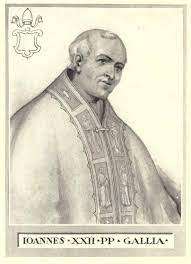
It is said that in 1316 the Holy Virgin appeared to Pope John XXII. She is thought to have spoken to him of a Sabbatine privilege, that is, of the salvation of souls from Purgatory on Saturdays. He is even said to have issued a papal bull about it, titled Sacratissimo uti culmine dated 3 March 1322, but this is largely considered apocryphal.[i]
In short, it was preaching of the Sabbatine privilege as an official doctrine was not allowed. Instead, priests were permitted to state that Mary would assist pious believers through her general, continuous motherly intercession — especially, but not exclusively, on Saturdays.
Further, ‘it is permitted to the Carmelite Fathers to preach that the Christian people may piously believe in the help which the souls of brothers and members, who have departed this life in charity, have worn in life the scapular, have ever observed chastity [according to one’s state], have recited the Little Hours [of the Blessed Virgin], or, if they cannot read, have observed the fast days of the Church, and have abstained from flesh meat on Wednesdays and Saturdays (except when Christmas falls on such days), may derive after death — especially on Saturdays, the day consecrated by the Church to the Blessed Virgin — through the unceasing intercession of Mary, her pious petitions, her merits, and her special protection.’ (Cf. summary approved by the Congregation of Indulgences on 4 July 1908).
(Talk delivered at Regina Angelorum Cultural Centre, Panjim, in July 1999. Expanded in July 2022)
To be concluded: 3 – Significance of the devotion for our day and age
[i] Successive Popes — Clement VII (Encyclical Ex Clementi, 12/8/1530), St Pius V (Superna dispositione, 18/2/1566, a papal constitution written motu proprio), Gregory XIII (Brief Ut laudes, 18/9/1577), as well as the Holy Roman General Inquisition under Pope Paul V (20/1/1613) issued caveats on the literal ‘Saturday rescue’ narrative.
Subsequent papal declarations and clarifications did not erase this structural caveat, but rather re-affirmed it. Pope Benedict XIV (in Opera Omnia) strongly encouraged the faithful to trust in the Scapular and the maternal protection of Mary, but maintained that the original medieval document itself could not be historically defended. Pope Leo XIII focused strictly on the practical and devotional aspects rather than changing the theological status. Through the Congregation of Indulgences (1901), he granted confessors the faculty to substitute or commute the stringent original requirements (like specific fasts) into more manageable pious acts, like praying the Daily Rosary. Finally, Pope Pius X in a decree of 1910 approved the use of the Scapular Medal as a replacement for the cloth version. He explicitly stated that all spiritual favours attached to the Scapular remained, but he did not alter the Holy Office’s structural caveat regarding the ‘Sabbatine’ definition.
Pope Pius XI issued an apostolic letter Neminem profecto latet (22/2/1923) to commemorate the 600th anniversary of the ‘Sabbatine privilege’. His successor, Pope Pius XII, wrote a letter for the 700th anniversary of the Scapular vision (dated 11/2/1950), colloquially known by its introductory Latin words, “De devotionis praestantia”. Pope John Paul II wrote a Letter to the Carmelite Families (25/3/2001), about his lifelong habit of wearing the Brown Scapular. He reaffirmed that the devotion represents a ‘covenant’ with Mary and her continuous protection, guiding souls toward eternal salvation.
I have learned a lot from this talk. I had not read of St Simon Stock’s beautiful prayer. Thank you Oscar.
Thank you, Laura! Hope you enjoyed the music too.
Thanks a lot for this very informative article. Just listened to that lovely hymn written by St. Simon Stock.
Waiting for today’s final article.
Mount Carmel is one of the most beautiful and serene places in the Holy Land. Blessed to have visited and experienced the same.