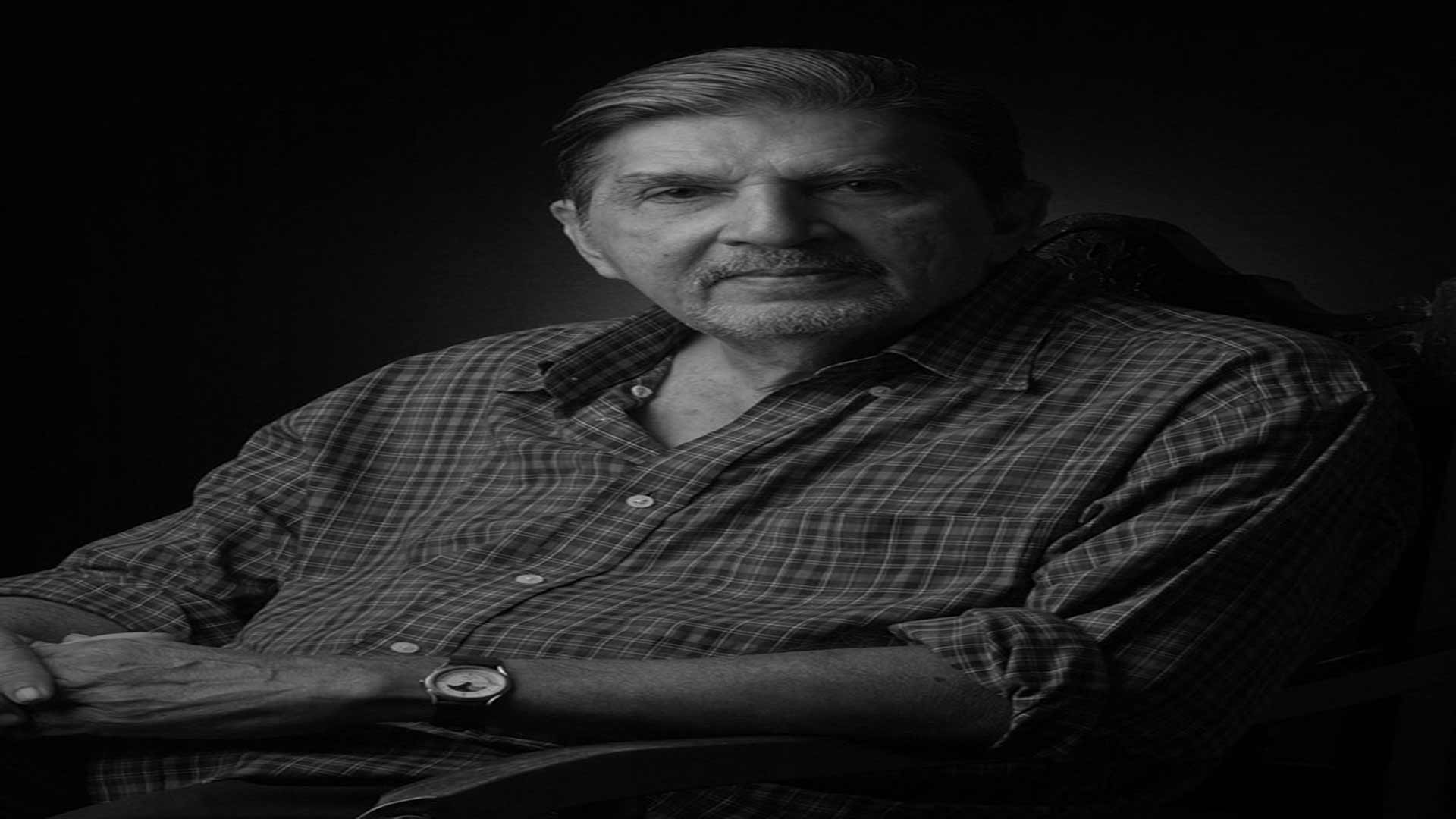
Mário: with malice toward none - 1
‘Mário is a subject that has no end.’ That is how Carolina Miranda, the centenarian cousin of the inimitable Goan artist, concludes her foreword to Diário do Ano 1951: Uma Campanha Alegre de Mário de Miranda (‘Diary of 1951: A Cheerful Campaign’), an upcoming book edited by this writer. She offers a close-up of Mário’s visual diary and how it made the rounds among relatives and friends. The Lisbon-based Carolina is a former teacher, poet, visual artist, and author of Histórias que contei ao meu gato — ‘Stories I told my cat’ — her memoirs, in which Mário figures prominently.
About Mário’s own fondness for animals, Fátima Miranda Figueiredo draws attention to her brother’s saying, ‘To err is human; to forgive, canine’ — which speaks volumes about his gentleness and empathy. He gave his pets long names and surnames, making them star characters in his diaries. In these, says Luís Pereira da Silva in his afterword, Mário ‘ably articulated what he experienced every day with lines at once quick and elaborate.’ The retired professor of paediatrics and amateur caricaturist adds that ‘Mário was always noble hearted in his irony, choosing affection and subtlety over scorn and sarcasm.’
Was it the artist’s unmalicious intent, then, that prompted Archbishop-Patriarch Dom José da Costa Nunes to let go when some clerics felt targeted by the young lad’s depictions? He was acquainted with Mário’s diaries and grateful for his help crafting the swan boat to carry the Pilgrim Statue of Our Lady of Fátima from Panjim to Old Goa. Mário, for his part, was relieved that his diaries had sparked guffaws rather than a controversy. ‘That was the first time I was appreciated by someone I didn’t know,’ he said.
Mário was a versatile artist, but best remembered and universally recognised as a cartoonist. Possibly one of the world’s youngest caricature diarists, he turned his journaling habit into a career. In March 1952, seeking an opening in Bombay, he toured editorial offices, his diaries in hand. Thoroughly impressed, The Current editor D.F. Karaka sent Mário to cover a can-can at the Taj Hotel. Mário returned with a rib-tickler that promptly secured him a cartoonist’s position at the weekly.
Mário was an instant hit, yet could not land a full-time role in Bombay. A fellow hosteller, Policarpo (Polly) Vaz of Bastora, suggested that he also draw picture postcards of the city landmarks and sell them at the Flora Fountain. Their bond grew so strong that they planned to move to Latin America together. But suddenly, Bombay proved to be more promising than Brazil when editor C.R. Mandy and art director Walter Langhammer invited Mário to join The Illustrated Weekly of India… and the rest is history.
Mário went on to become one of the country’s best loved social cartoonists. His iconic characters, like Ms Fonseca, the Boss, and clerk Godbole; the corrupt politician Bundaldass and his sidekick Moonswamy; Bollywood stars Rajni Nimbupani and Balraj Balram, appeared in the Times group of publications. Generations grew up with those cartoon characters that are etched in collective memory, although the world’s ever-changing sensibilities tend to put a negative spin on some of them.
All of Mário’s works, be it Goa with Love, A Little World of Humour, Laugh It Off, or others, show him as a tireless seeker of the comic side of life. In Bal Bharati textbooks and Air India in-flight magazines alike, Mário’s drawings were always teeming with human specimens, each with their own story to tell. His hawk eye caused the poet Nissim Ezekiel to remark that there is ‘no escape if Mario is looking at you. The buffoonery of his human figures is redeemed from grossness by their verve, their inner urge towards going places, getting somewhere. It is not always their fault that there is no place to go, nowhere to get except through the corridors of illusion.’
The artist’s own ‘inner urge towards going places’ was clear on his first-ever trip abroad, to Portugal. Later, Mário went freelance as a cartoonist to satisfy his wanderlust. By his magical ability to capture the spirit of a place, he received assignments to sketch vignettes and hold exhibitions across the globe. Veteran editor Vinod Mehta saw no contemporary artist in India coming close to Mário’s command over the grammar of drawing; the alleged ‘lack of venom’ in his repertoire spoke for his ‘objective perspective,’ he said.
According to art critic Ranjit Hoskote, Mário’s confluential, Indic and Iberian, heritage ‘gives him an amplitude of cultural references [and] a historically informed sensibility.’ Bombay’s Cocktail magazine once said that Mário’s illustrations have ‘polished perfection and have been such a success that all our writers want Mario to illustrate their work.’ He took as much pleasure to draw for journalists as he did for literary giants and lesser writers. A much sought-after muralist, he is perhaps the only Indian cartoonist whose works adorn the landscape.
Prakruti Ramesh, in her hitherto unpublished thesis titled Making a Public Aesthetic: Heritage, Humour and Regional Identity in Goa, examines why Mário’s images have fascinated architects, urbanists, educators, and tourism entrepreneurs and have been used as a form of public art in Goa. While she draws many weighty conclusions, one can also say that, thanks to Mário’s malice toward none, he has touched a chord in the Goan soul and is also capable of raising the happiness quotient of the big wide world.
To be continued... See three items in the next blogpost: Key Milestones; Mário's Diaries; Mário's Characters
(First published in Herald, Café magazine, 2 May 2026)

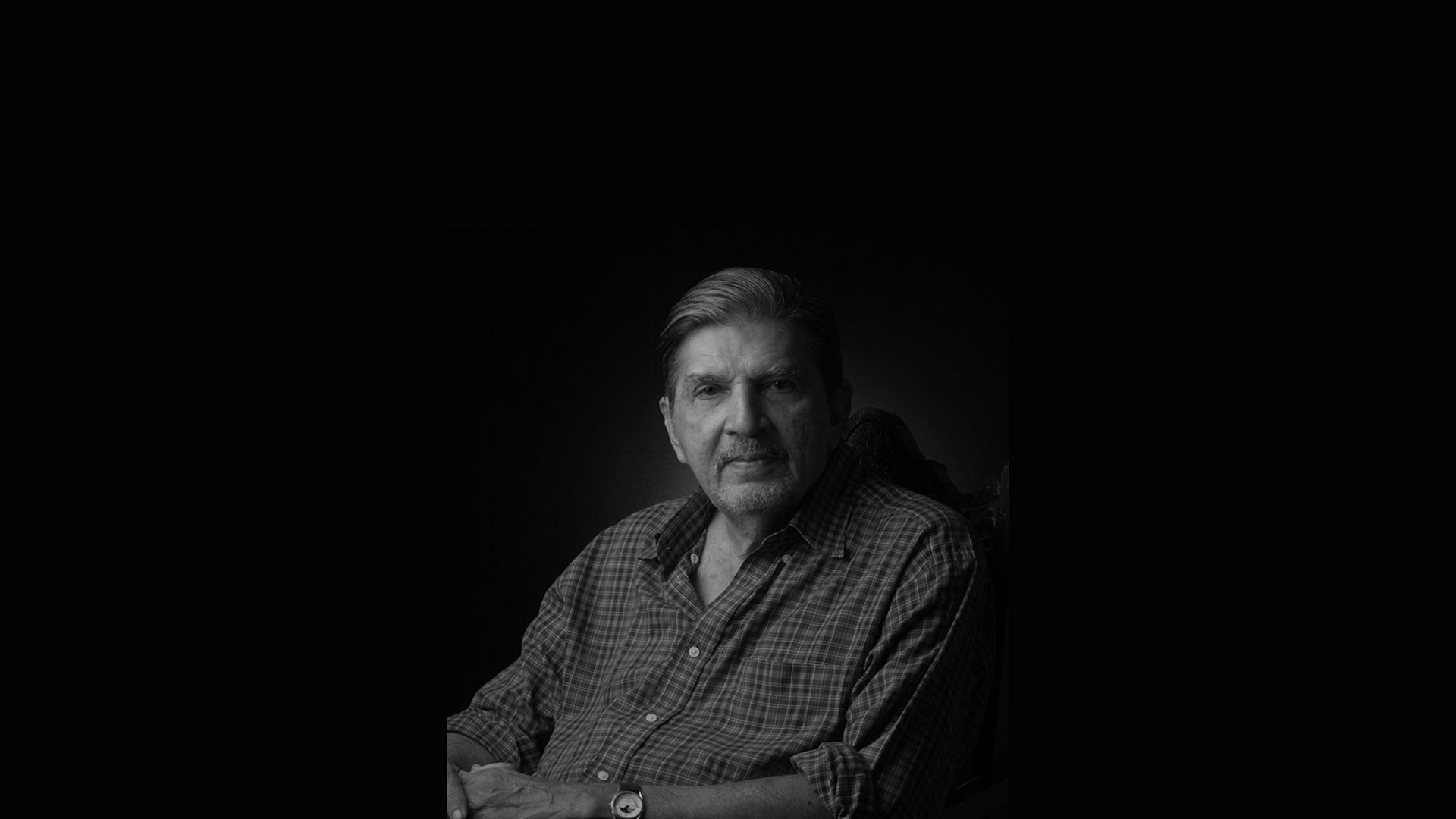
Story of Mário, the Miranda (Part 5/6)
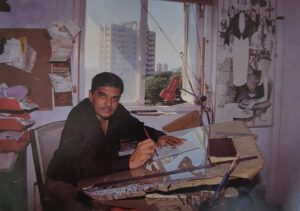
Reinventing himself
By his fiftieth year, Mário had developed an abiding interest in illustrating books. After Ruskin Bond’s The Room on the Roof, Uma Anand’s books for children,[69] and several business publications; Dom Moraes’ The Open Eyes: a Journey through Karnataka and A Family in Goa (1976); Manohar Malgonkar’s Inside Goa (1983), Lambert Mascarenhas’ In the Womb of Saudade (1994) and Mário Cabral e Sá’s Legends of Goa (1998) confirmed him in the art of book illustration.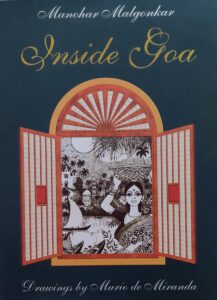
Now practically at the end of his career, doing illustrations for a book in Portuguese – Momentos do meu Passado (2002), by Fernando de Noronha – ‘brought back nostalgic memories of my youth spent in Goa,’ Mário said.[70] Victor Rangel-Ribeiro for his part recalls that when he proposed to the publishers that Mário be the illustrator for Loving Ayesha (2003), ‘first they said he would never agree; and when he agreed, they said he would be late with the drawings. He surprised us all by delivering the drawings on schedule.’[71]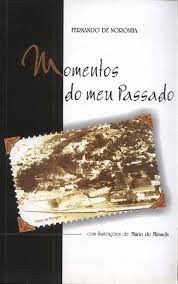
Interestingly, Goa-based projects marked the beginning of Mário’s homeward journey. In 1979, the movie buff of yesteryear acted as a creative assistant for Sea Wolves, a war film shot in Goa. In 1985, Shyam Benegal’s film Trikaal based itself on snippets of the Miranda family history; it was shot in their heritage home and village, the film director deeply appreciative of India’s Latin character available only on its west coast.[72] The mansion, refurbished for the occasion, soon began to figure in coffee table books and glossy magazines.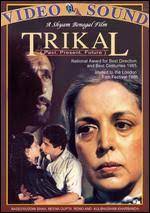
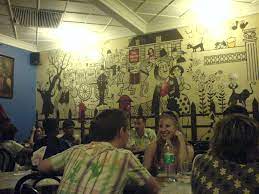
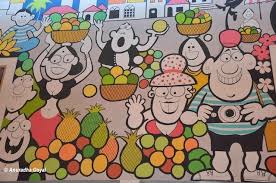
Mário is possibly India’s only cartoonist whose sketches have been turned into murals. His first one came up in 1986, at Hotel Mayfair, in a quaint corner of Panjim. The next two locales were at Colaba: Café Mondegar, his favourite haunt, and Hotel Paradise.[73] Mário also honoured Goa’s Krishnadas Shama Library[74], Panjim’s municipal market complex,[75] and other locations in the country with his murals. The adaptation of Mário’s characters by Air India and by the Charles Correa-designed Kala Academy in Goa was yet another feather in his cap.[76]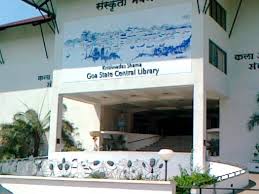
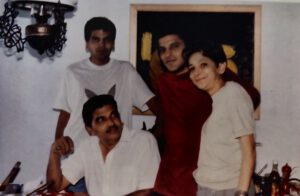
In 1996, the Mirandas gave up their rented place at 7A, Oyster Apartments, Navy Colony, Colaba, and returned with their dogs, turtles, parrot and all to the same sleepy little village of Loutulim that was frozen in time almost just as Mário had left it half a century earlier. The homecoming far from ended his love story with Bombay, though; he continued infusing The Afternoon and The Economic Times with his brand of humour. And in the evening of his life the inveterate cartoonist was a welcome presence in Goa’s social and cultural circles as well.
The Goan Cause
Life had come full circle for Mário. ‘What I enjoy most is doing nothing, if I could… – back to the sossegado times!’ he said.[77] Yet he was always brimming with ideas; and even if a wee bit mystified by Goa’s half-hearted response to his work,[78] or so he thought, the quintessential Goan gentleman had many dreams to fulfil and promises to keep.
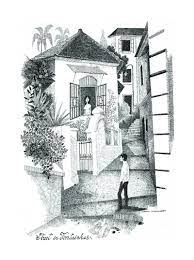
‘Goa has a different atmosphere from the rest of India. After all, Goa was with the Portuguese for 500 years…,’[79] said Mário. He planned to do a series of drawings ‘on my Goa, the Goa that I grew in, the past; the Goa which lots of people did not know existed.’ Considering it critically endangered, he wished to preserve it in his own way.[80] ‘Today, Goa is part of India, so naturally we will lose a lot and gain a lot,’ he said, hoping at the same time that ‘some of the heritage of the past remains and gives Goa this identity that I think it needs.’[81] According to art critic Ranjit Hoskote, Mário’s confluential, Indic and Iberian heritage, ‘gives him an amplitude of cultural references [and] a historically informed sensibility.’[82]
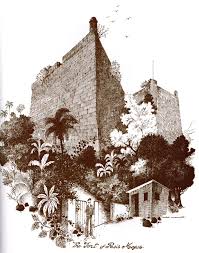
As the convenor of the Goa chapter of INTACH (Indian National Trust for Art and Cultural Heritage), Mário was instrumental in getting the Gulbenkian Foundation to sponsor the establishment of a Museum of Christian Art at the Seminary of Rachol. He also secured funding from Lady Hamlyn Trust, London, for the restoration of the iconic Reis Magos Fort.[83] And even though daunted by politics and red tape, he lent his expertise to public institutions like Goa University, Kala Academy and Goa International Centre.[84] It is ironic that the consummate Goan artist who could make light of just any situation found little reason to smile when it came to the State handling of tourism, environment, animal welfare and heritage issues.[85]
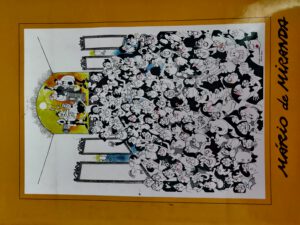
Meanwhile, Mário encouraged fashion designer Wendell Rodricks to document the Goan costume, through the Moda Goa project;[86] and artist Victor Hugo Gomes to study Goa’s ethnography,[87] an experiment that led to the creation of the Goa Chitra Museum. As regards his own oeuvre, Mário was fortunate to see part of it documented in a large-sized book titled Mário de Miranda as well as displayed at Mário Gallery, by architect Gerard da Cunha.
Acknowledgements: (1) I am indebted to Fátima Miranda Figueiredo for her knowledge and patience translated into many hours of whatsapp chats about her brother Mário and the family; and to Raul and Rishaad de Miranda for their warm welcome and lively conversation. (2) Banner picture: Portrait Atelier Goa (3) Article first published in Revista da Casa de Goa, Lisbon, Series II, No. 12, Sep-Oct 2021
[69] The Room on the Roof was first serialised in the Weekly, in 1956; and Anand’s Dul-Dul, The Magic Clay Horse, The Adventures of Pilla the Pup, and Lumbdoom, The Long-Tailed Langoor) were published in the 1960s. Mário also worked on films for children, sometimes for free, Cf. Conversation with Shri Mario Miranda – 2 (Outtakes), op .cit.
[70] Mário’s statement to my father. Cf. Fernando de Noronha, op. cit.
[71] Email of 25.6.2021.
[72] Telephone conversation on 2.7.2021.
[73] https://www.thehindu.com/features/friday-review/art/his-drawings-had-a-special-quality-rk-laxman/article2707166.ece Retrieved on 8 August 2021. Mário chose not to sign the mural, possibly because the artwork was put together by students of J.J. College. Others were done by one Shetty, cf. Conversation with Shri Mario Miranda – 2 (Outtakes), op. cit.
[74] Façade mural and interior panels: project executed by Orlando de Noronha’s firm Azulejos de Goa, Panjim, in 2011.
[75] Executed by Panjim-based Rajesh Salgaonkar, 2005.
[76] Some undertaken by Deepak from Meerut, cf. Conversation with Shri Mario Miranda – 2 (Outtakes), op. cit.
[77] ‘Tale of Two Goans’, op. cit.
[78] FTF Mario Miranda, op. cit.
[79] ‘Tale of Two Goans’, op. cit.
[80] Ibid.
[81] Ibid.
[82] Ranjit Hoskote, ‘The Art of Mario Miranda’, in Mário de Miranda, op. cit., p. 81.
[83] In both projects he had the support of Bal Mundkur; Bartand Singh and Smith Baig of INTACH.
[84] Mário was declared Goa Today’s Man of the Year. Cf. interview with Alexandre M. Barbosa and Alister Miranda, in Goa Today, December 1998, pp. 18-23.
[85] Doordarshan National, Eminent Cartoonists of India, #04, op. cit.; Goa Today, ibid.
[86] https://www.firstpost.com/india/moda-goa-designer-wendell-rodricks-on-indias-first-costume-museum-and-his-vision-for-its-future-5510481.html Retrieved on 19 Aug 2021
[87] https://timesofindia.indiatimes.com/city/goa/dont-call-me-sir-call-me-mario/articleshow/11456423.cms Retrieved on 19 Aug 2021