
God above Self
Placing God above ourselves in word and deed is a sign of our openness to His presence and action in our lives. When we receive God’s representatives, we welcome God Himself; when we place ourselves at their service, it is the Almighty who we serve. In fact, we cannot do without Him: a reminder to the contemporary world that has closed in on itself.
The First Reading (2 Kings 4: 8-11, 14-16a) introduces us to Elisha and to an unnamed, wealthy woman who served him and, upon discerning his holy vocation, sheltered him. Elisha, the son of a wealthy landowner, had left hearth and home when he was selected to succeed Elijah in the prophetic mission. He spent time with Elijah on Mount Carmel; later, he served as royal advisor and became known throughout the kingdom as a wonder worker—not least among the wonders being the blessing of a child to his long childless benefactress.
However, the focus is not on accomplishments but on total trust in God and commitment to His message. This is a point that Our Lord highlights in the Gospel (Mt 10: 37-42) when He says that those who love their kith and kin more than they love Him are not worthy of Him; those who love their life are bound to lose it, whereas those who lose it for Jesus’ sake will find it. Whoever takes exception to the Lord’s words knows neither the ways of the world nor the ways of Our Lord: The world appears sweet but is deceitful, whereas Jesus, who comes across as harsh, is truthful.
Jesus is no politician currying favour with His people. He is incredibly frank, straightforward, even blunt–but never false. He does not promise us a bed of roses; on the contrary, He invites us to take up our crosses. He does not encourage us to seek service but to serve as He did, unto death. He does not point to a highway but to the narrow path to Heaven. Had we—not individuals alone but countries as a whole—wholeheartedly embraced the philosophy of the Gospel, the world would have been a better place to live in.
Pope Leo XIII, in his memorable encyclical Immortale Dei (1885)[1] [1], reminds us of how once upon a time the world had found favour with God: “There was once a time when States were governed by the philosophy of the Gospel. Then it was that the power and divine virtue of Christian wisdom had diffused itself throughout the laws, institutions, and morals of the people, permeating all ranks and relations of civil society. Then, too, the religion instituted by Jesus Christ, established firmly in befitting dignity, flourished everywhere, by the favour of princes and the legitimate protection of magistrates; and Church and State were happily united in concord and friendly interchange of good offices. The State, constituted in this wise, bore fruits important beyond all expectation, whose remembrance is still, and always will be, in renown, witnessed to as they are by countless proofs which can never be blotted out or ever obscured by any craft of any enemies. Christian Europe has subdued barbarous nations, and changed them from a savage to a civilized condition, from superstition to true worship. It victoriously rolled back the tide of Mohammedan conquest; retained the headship of civilization; stood forth in the front rank as the leader and teacher of all, in every branch of national culture; bestowed on the world the gift of true and many-sided liberty; and most wisely founded very numerous institutions for the solace of human suffering. And if we inquire how it was able to bring about so altered a condition of things, the answer is beyond all question, in large measure, through religion, under whose auspices so many great undertakings were set on foot, through whose aid they were brought to completion.”
Contrasting the Pope’s prophetic words with our current situation: The world is in a shambles, with atheism, materialism and individualism reigning supreme. No wonder Russia has spread its errors across the world and is now attacking Ukraine for petty gains; France, formerly considered the eldest daughter of the Catholic Church, has been facing unrest; and in our country, the social and political scene is unbelievable – so enormous that our Shepherds finding themselves speechless have left the sheep to be devoured by the wolves. Against the particularly devastating scenario in Manipur, Archbishop Peter Machado of Bangalore has been the lone voice crying in the wilderness[2]—God bless him! Meanwhile, the encouraging words from the state's new dispensation for the services traditionally rendered by the Christian community have provided human solace to the archbishop. Proof that the Lord keeps His promises and never abandons those who stand by Him.
Against this dismal background, only the Gospel can give us hope, set us free. St. Paul in the Second Reading (Rom 6: 3-4, 8-11) invites us to reflect on the fact that, with baptism in Christ, we die to sin and are on the path to our final glorification. Therefore, putting God above everything is a good idea. We could well say that only devponn (divinity) can protect our munisponn (humanity), only godliness can save our humanness. That is Jesus’ radical call for discipleship.
So, let us shed our natural approach to life and live supernaturally, putting God first in everything we do. Such a worldview may alienate those kith and kin accustomed to overrating the world, but it will surely keep us at peace with God. We ought to allow nothing to come between us and our God and Saviour, to whom we owe our very existence.
Banner: https://shorturl.at/Zb7ZI
[2] This is a reference to the situation in the year 2023, when this reflection was written.


The Other Side of Mercy
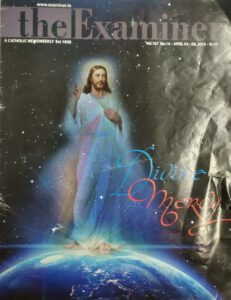
With Pope Francis’ Bull of Indiction Misericordiae Vultus (The Face of Mercy), God’s mercy has come into sharp focus – and rightly so. But, at the same time, are we obscuring its reverse side – the reality of Divine Justice ?
After quoting the Bible profusely to prove that God’s intrinsic nature is Mercy, the Pope goes on to cite his predecessors – first, John XXIII, who at the beginning of the Council said, “Now the Bride of Christ wishes to use the medicine of mercy rather than taking up arms of severity…”; and second, Paul VI, who at its conclusion stated that “a wave of affection and admiration flowed from the Council over the modern world of humanity. Errors were condemned, indeed, because charity demanded this no less than did truth, but for individuals themselves there was only admonition, respect and love. Instead of depressing diagnoses, encouraging remedies; instead of direful predictions, messages of trust issued from the Council to the present-day world.”
These words may have been evocative fifty years ago, fresh as the world was from the cruel acts of the two Wars and their convulsive aftermath; whether today they can be taken literally is debatable. Hasn’t the mass of humanity and individuals per se changed beyond belief? In fact, many an assessment of the Council points to a weakening of our religious faith and practice. Closer to our times, John Paul II, influenced by Sister Faustina, reiterated the theme of mercy, in Dives in Misericordia. But meanwhile, there was a further shift in modern man’s world view. Probably, this stemmed from the line of least resistance that the Church had adopted against the world’s vile tendencies, as is evident from Paul VI’s words on the said occasion: “The modern world’s values were not only respected but honoured, its efforts approved, its aspirations purified and blessed…”
Before long the entente with the world went awry. The new sense of freedom eventually brought about loss of the sense of sin (as the present Pope himself has elsewhere pointed out); so now we queue up quicker for Holy Communion than for Confession! That newfound freedom has spiralled into amoral, immoral, and blatantly anti-Catholic stances on the part of some of our ill-advised co-religionists; it has erected a sheer façade of spiritual health and a make-believe atmosphere of well-being, even while the community’s moral and spiritual fibre is weakening.
Will merely soothing words help restore the balance? Will not ‘Mercy’, used loosely – much like ‘Love’ that is now more readily seen as eros than as agape – eventually be a casualty? It probably will, if we continue to proclaim it from the rooftops without the least contemplation of Justice. In Misericordiae Vultus, Justice finds a place after nineteen sections extolling Mercy; even then it is equated with a tendency toward legalism. Finally, the reminder that, “for his part, Jesus speaks several times of the importance of faith over and above the observance of the law”, may have put many on the back foot.
But presently we would only stress the importance of gazing at the face of Justice. Aren’t many ills of the contemporary world a consequence of the neglect of the divine law and justice? Much like our school children nowadays accustomed to ‘automatic promotions’, only to be shocked when confronted with the spectre of the Board examinations, leniency in spiritual matters could have a like effect even for believers. Would it therefore not be better to have our senses so sharpened that we take to justice like fish to water? The wheels of society would then be well oiled and running smoothly; we would live with honour and in peace.
In Immortale Dei, Pope Leo XIII notes that “there was once a time when States were governed by the philosophy of the Gospel.” Today, in stark contrast, secular and atheistic philosophies have resulted in heterodox and muddled thinking. The teaching authority of the Church has to step in firmly and help the faithful swim against the tide. The aid thus received would be useful in practical, day-to-day matters, and vital from the perspective of the Judgement. Unless we are used to the idea of justice, will the certainty of the Judgement sink in?
To conclude: Favouring Mercy to the detriment of Justice would be a disservice to God and Man. The two are not antithetical; in fact, justice without mercy is cruelty, said St Thomas Aquinas; but mercy without justice is the mother of dissolution, he added. So let’s talk of Mercy and Justice in the same breath, and then have a “faithful abandonment of oneself to God’s will”.
(Published in The Examiner (Bombay), Vol. 167, No. 14, 02-08 Apr 2016)