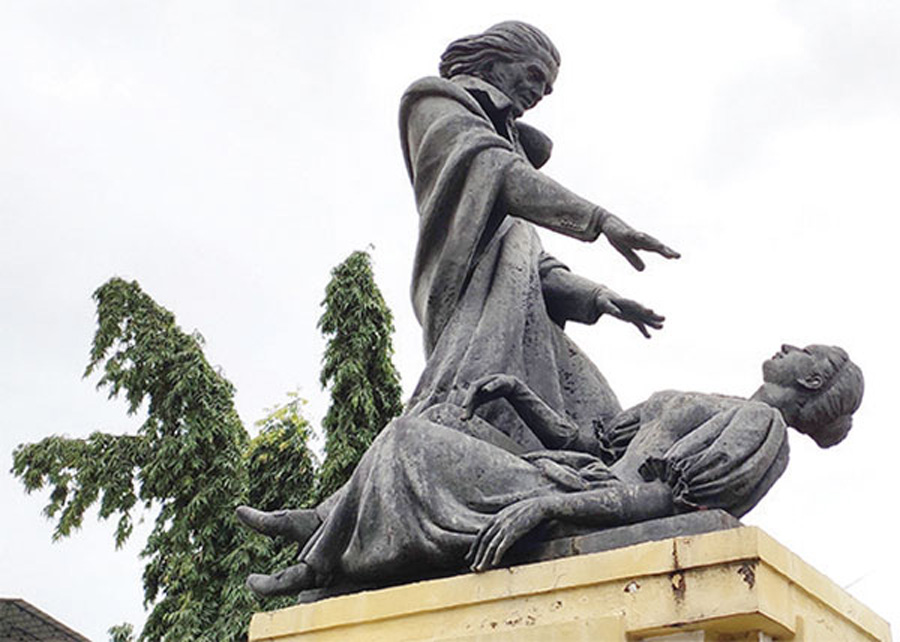
Abbé Faria: one of Goa’s first global citizens
Link to the original interview in Portuguese on Renascenca Goa podcast https://www.youtube.com/watch?v=wnBCV6fCgTI
ON: September this year [2019] is the month of Abbé Faria, marking two hundred years since his passing… Let’s start by talking about your interest in Abbé Faria…
ISRV: I have such great respect for Abbé Faria that I believe every year is a year dedicated to Abbé Faria. His contribution, in so many ways, is something we must not forget, and I am delighted that you have taken an interest in this figure, this subject and this date.
The person who first planted the seed in my mind to undertake a slightly more in-depth study of Abbé Faria was Mr Matanhy Saldanha. He invited a few people round for tea and discussed whether it might be possible to do something — let’s say, a small museum or some other activity — to honour the great figure of Abbé Faria. At that time, Mr Matanhy Saldanha was a member of the Government, but a few months later he was no longer in government, and the whole project fell through.
But I didn’t lose interest. I’d already started reading up on it, and at that point I discovered that, many years earlier, my brother, Luís, had written an article. When I read that article, I became even more interested, and both Luís and I continued to do a bit of research. He did far more than I did, but I made use of the information he’d gathered to carry out some work of my own later on.
That’s when my interest really took off. But we found more and more information, and more and more people who had, in one way or another, been in contact with Abbé Faria, so it turned into a truly fascinating journey.
FILM ON FARIA
ON: How did you take this interest further? Did you make a film?
ISRV: Yes, I took part in a short course in film-making or video-making. And when we reached the end of the course, each of us had to decide on a project, based on how we would have made a film. When one of my classmates, Cecil Pinto, and I began to delve deeper into our interest in Abbé Faria, we thought, why not make this documentary?
By that point, I already had plenty of material, so the idea for a documentary emerged, and we decided that, since there were people around us who had the relevant knowledge, the film should be interview-based…
ON: To prepare for this documentary, In Search of Abbé Faria https://www.youtube.com/watch?v=2mdL24UOXVs, can you tell us which authors you read and the people you spoke to, because, nowadays, finding people who know about Abbé Faria’s life must be quite rare…
ISRV: The Central Library was a very rewarding place for me because I was able to read what Egas Moniz says about Abbé Faria, what Gelásio Dalgado says about Abbé Faria, and a whole host of newspaper articles… Gomes Catão and various other people who wrote about Abbé Faria… It’s all on record…
ON: I hope we’ll now take an interest in the information you have provided, given that the Library is really very well organised…
ISRV: Very well organised indeed, and with such a rich collection… And if anyone shows an interest in reading something, they help — they really do help — and it was easier because my brother Luís had already looked into several of these authors, so I knew where to go and what to read…
RESEARCH ON FARIA
ON: You already had some leads… But when you spoke to people, did you find anything new, or was it just a repeat of what was in the books?
ISRV: We found two people. We knew these people existed, but we got in direct contact with them: one was the Russian Professor, Mikhail Buyanov. We sent him an email and he replied. He wasn’t very fluent in English, but he replied through a colleague. And we’d already read the chapter in his book Psychiatry and You.
We also contacted a lady, an Italian teacher, who has written several books on Portuguese theatre. She was an Italian, no doubt, but Portuguese at heart, so to speak. She told us things that really made our trip even more interesting… She told us that both she and her husband had collected a great deal of material on Abbé Faria. She was unable to share it with us because, meanwhile, she passed away: Luciana Stegnano Picchio.
So, for those in Italy, it’s quite possible they’ll get more material. And I’m sure there must be more newspapers in France, as well as other records in churches and various other places, and scholars too – perhaps more recent ones…
ON: And in Goa?
ISRV: Here in Goa, we’d already contacted people. We already had an idea of what they knew, but sometimes we came across additional information. For example, Dr Manohar Sardessai. Certain things he said stuck in my mind. The story that the Abbé was supposedly imprisoned at the Château d’If: it’s not history, it’s perhaps a legend.
But what Professor Sardessai said was that here in India, legend is more important than history, and that history does not become reality until it turns into a legend... So, if we think of it in this way, Abbé Faria is as much history as he is legend…
ON: That is why Abbé Faria continues to live on… Did you find any of Faria’s relatives?
ISRV: We were very lucky to find Mr William Faria in Candolim – a great-grandnephew, I believe. We visited Mr Faria and when the film was screened in Panjim, he attended… He was already over 80 years old.
I’d also like to mention that we visited Abbé Faria’s house in Colvale. It was already in ruins by then, but there was a sign that read ‘Solar dos Farias’ (Faria Mansion). It was a beautiful house, though in ruins, and in such a lovely spot overlooking the river and the beach…
ON: Is it the same one with a chapel nearby? Doesn’t it belong to José Nicolau da Fonseca?... It isn’t Abbé Faria’s original house, is it?
ISRV: I think part of it was original and was rebuilt, and now even the part that was rebuilt is completely in ruins…
ON: Well, the people you spoke to must have said something new. Do you remember anything?
ISRV: There are certain things that were said which we can’t really confirm. For example, Professor Mikhail Buyanov spoke of the chess set that was enlarged by Abbé Faria: these things are unheard of in Goa. Perhaps it’s true, perhaps it isn’t, but it’s also an interesting legend…
ON: Did Buyanov ever visit Goa?
ISRV: Yes, he did, and we have a photograph of him near the statue of Abbé Faria.
FARIA’S LIFE
ON: Moving on to Abbé Faria’s life. What were the key milestones in the life of José Custódio de Faria?
ISRV: There were various stages in his life, and all of them, I think, left their mark in some way on his heart. For example, his childhood, the years he spent in Goa aged 14 and 15: I think they must have had a significant influence on him.
One person who is forgotten, let’s say, has not been forgotten by me, for in the play I wrote about Abbé Faria titled Kator Re Bhaji, one of the main characters is Catarina, who was José Custódio’s adopted sister. I am convinced that this girl, who was more or less the same age as José Custódio, must have had some influence on his imagination. When he was in Lisbon – and both he and his father had lost touch with Goa — he wrote a single letter to a neighbour in Candolim and sent an oratório (oratory) to his sister Catarina. One wouldn’t send an oratory to someone for whom one has no affection whatsoever. So, for me, that oratory is a symbol of the attachment he felt for Goa.
Furthermore, in the book he wrote [De la cause du sommeil lucide — On the Cause of Lucid Sleep], there are words in Konkani. He speaks of ‘mutt marop’, ‘tel lavop’, which shows that his childhood was not very different from ours in Goa: the same sort of family, the same family care… So, I think his time in Goa was important in his life.
Then there was the journey to Portugal by boat: what a great adventure! In Lisbon, father and son knew the language and had some contacts, but I think Rome must have been even more interesting — for the father, but even more so for the boy — because he was going there to study, and there must have been teachers, libraries, and books there that made him think of a wider world.
He returned to Portugal and I think that marked a third phase, which must have been quite difficult. We’ve spoken of the ‘Kator re bhaji’ that the father said to his son… Was the father referring only to that particular speech, or to the whole of life — the future that lay ahead of this young man — which wasn’t going to be easy?
What’s more, the father soon found himself shut away in his own home, and the boy had to leave for France. He spent a significant part of his life in France, where he was very well known, and then became completely disoriented because people made fun of him. He died utterly destitute and humiliated.
FARIA’S FATE
ON: One thing that strikes me is that this family never met again…
ISRV: I get the impression that the father always wanted to return because, when he arrived in Rome, he tried to buy the typefaces for Malayalam and Tamil. He was a scholar. He had a love for India and a nativist streak, as we say; so, I’m convinced that they intended to return, but the political situation was such that they were never able to…
ON: His gesture towards Catarina reveals the affective side of José Custódio de Faria. Don’t you think this is a side of Abbé Faria that hasn’t received much attention?
ISRV: For me, personally, there are two aspects that have not been explored: one was this, the family aspect, and the second was the spiritual aspect. He was a priest — let us not forget that. The speech he gave and the research he undertook were on the Holy Spirit. I do not think these were superficial matters. When he was studying the human brain and hypnotism, might he not have been thinking about the human spirit? I am certain that he must have pursued that line of thought. It is a very personal certainty, a personal conviction.
Therefore, certain aspects of José Custódio’s spirit were so intimate that not everything was said, and it was in this spirit that I wrote that play…
[Next, Catarina’s song, composed and performed by classical guitarist Rui Lobo for the play Kator Re Bhaji]
ON: In this whole story of Abbé Faria, there is much more to be done in terms of research in archives and libraries, talking to people, and so on, but also in terms of the tribute itself… So, what remains to be done?
ISRV: Professor Matanhy had the idea that the house in Candolim could be turned into a museum without too much difficulty, because the house now belongs to the Provedoria, but it didn’t go ahead. It’s something that can be done now.
Another suggestion we put forward at the time was that the Indian Government could have issued a commemorative stamp. The Portuguese Government produced a first-day cover featuring a bust of Abbé Faria. In India, we have done nothing of the sort. I believe that not only in Goa but throughout India, people need to learn about this figure — perhaps one of our first global citizens.
ON: With these very interesting words from you and your perspective, we thank you for this interview and hope that you will continue to take an interest in Abbé Faria!
ISRV: Thank you!
Isabel de Santa Rita Vás has been a teacher by profession for over three decades, and is now retired; she taught in school, college and is on the guest faculty of Goa University. She is a founder member of the Mustard Seed Art Company, an amateur theatre group that has been performing plays for the last 39 years. She has written a number of plays, often directs them and has written the scripts of a few video-films commemorating interesting Goan personalities like Abbé Faria, Dr José Pereira, and writer Victor Rangel-Ribeiro, all made in collaboration with Cecil Pinto.
First published in Revista da Casa de Goa, Series II, No. 42, Sep-Oct 2026, pp 68-72
