
First, some history about the Old Goa chapel, which is closely associated with St. Francis Xavier’s memory. Whether or not he built it, he often said Mass there. He quenched his thirst at a nearby well and rinsed his dusty feet at another. This happened after his rounds of the churches, where he taught catechism, and the hospitals, where he tended to lepers and others. The chapel and the wells, which were formerly within the enclosure of the College of St Paul, where St Francis Xavier was once the Rector, have long been pilgrimage spots.
One day, either inside the chapel or at that site, the Jesuit missionary was so overpowered by devotional fervour as he prayed that he felt almost suffocated. Opening his cassock near his chest, he exclaimed, ‘Satis est, Domine, satis est!’ (Enough, Lord, enough).[1] There are others who say that it was a vision of heaven that comforted him in his Oriental toils.[2] This incident is said to have been crucial either in changing the name of the chapel from St Jerome to St Francis Xavier, or, if there was no chapel there, the present one was possibly built to commemorate the heavenly occurrence.

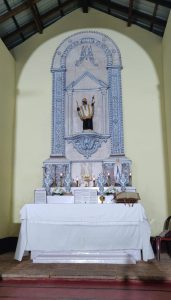 Coming now to the day I attended a Tridentine Mass in the said chapel… It was the 3rd of December 2024. Neither the nip in the air nor the traffic congestion on the feast day prevented people from flocking to the place. Despite the location being a kilometre away from the Basilica, which was the epicentre of the day’s action, I could not easily find a parking spot in the vicinity of the chapel. Men, women, and children in their Sunday best had come from far and wide, and some more were trooping up the gentle slope to the chapel. It took me back to the days when people used to make a beeline to church or chapel on Sundays and feast days…
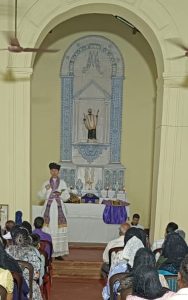
When I arrived, I found the congregation eagerly waiting for the Mass. Their prayerful posture touched my soul. In a few minutes, a priest, attired de rigueur in a black cassock, arrived with the acolytes to ensure that everything was in place. The incense smell and the reverential silence magnified my sense of anticipation, and I felt good when the Mass began. There was nothing difficult or strange about it. Latin came across as my very own.
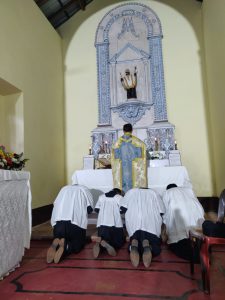
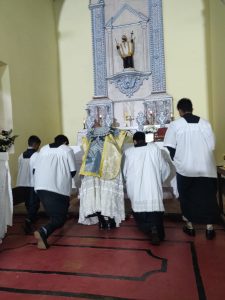
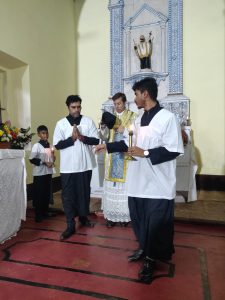
I could also relate to the parts of the Traditional Latin Mass. The canon has remained largely unchanged since the time of Pope Gregory the Great. The Mass includes more invocations to the Trinity, Mary, and saints than the Novus Ordo Mass. The Lectionary is incensed before the reading of the Gospel. The administration of Holy Communion too is impressive. It is a defining moment. At the chapel, the communicants knelt at the place where a special railing once stood and received the sacred host on the tongue. Reverence and awe were unmistakable. I felt drawn closer to the Holy Presence of God; I felt a sense of belonging to God’s City.
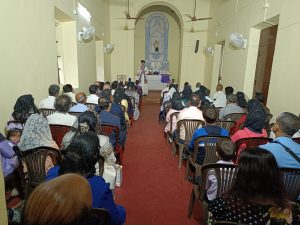
Finally, a word about the sermon. This is a part of the Mass meant for instruction: to explain the biblical readings and prepare the faithful for other sacred rites that follow. The priest, Fr. João Silveira, a Portuguese, who belongs to the Missionaries of the Holy Cross, preached in English, as it is a standard practice in the Traditional Latin Mass to have the sermon in the local language for the congregation’s understanding. The aura of the consecrated minister spoke louder than words.
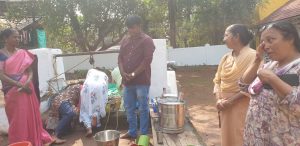
After the Mass, the congregation greeted each other outside. Godly conversation. The most important item available for everyone to share was the water from the same well from which St. Francis Xavier drank. I heard pilgrims testifying to its healing properties for both the body and soul. Some claimed that they had visions of the Saint of Old Goa as they looked inside the well.
While I am grateful to the hundreds of priests whose Masses I have attended and prayed at in the last half-century, as I returned home that afternoon, I considered the irony of favouring local languages and congregation-facing altars to bring the Mass to the people, for alas, people nowadays fail to bring themselves to the Mass as they did it in illo tempore…
[1] J. N. da Fonseca, An Historical and Archaeological Sketch of the City of Goa (Bombay: Thacker & Co, 1878), pp. 266-268.
[2] Velha Goa: Guia Histórico (Goa: Edição da Repartição Central da Estatística e Informação, 1952), p. 123.
Every action, posture and delivery of the celebrant has such a meaningful delivery. It may appear gloomy at times having the priest face the Altar but the entire environment including the modesty in clothing of the faithful and gestures takes ones heart closer to where it should be with no distractions as one can notice in the present day informal Mass.
I remember as an Altar boy from age 5 till around 1964 all Masses were in the Latin language. I was very fond of the Mea Culpa said kneeling beside the priest when you needed to move the head closer to the priest at Mea Culpa. I was even singing the long prayers solo before the Masses for the dead when the priest wore black. Looking back I have great nostalgia.
Would I wish Latin Mass would come back? I don’t know. Maybe the special reverence that was present and gestures could be introduced in the modern Mass.
Thank you dear Oscar for narrating your experience and giving the Chronology of events.
The fullness of the Christian faith is found within the Catholic church and the most Holy Sacrifice at the Altar.
The Traditional Latin Mass was celebrated with great piety and reverence by Fr. João Silveira on the feast of St. Francis Xavier. I felt blessed during the Mass and I am looking forward to attend many more Latin Masses in the future.
The sublimity of the Traditional Latin Mass will bring the youth back to the church and will fortify the faith of many Catholics.