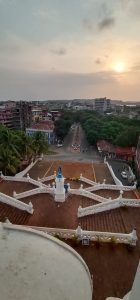
Panjim’s Immaculate Conception Church, with its zigzag stairway and whitewashed exterior, is a major attraction. Sitting high up on Conceição Hill, it crowns the city-centre landscape to a tee. No one goes by without looking twice at the majestic edifice or stopping to hear the church bells ringing. The rich and mellow tone of the main bell is a gift to the city’s soundscape. Today marks the day when it was first heard from the belfry 150 years ago.
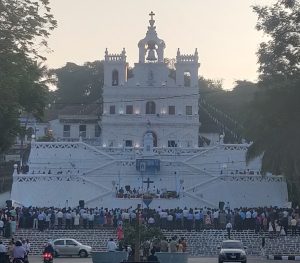
The bell has a long history of travel. It was cast in 1749 by João Nicolau Levachi of the Royal Foundry of Lisbon, by order of Friar José de São Patrício, Prior of the Augustinian monastery in the Rome of East. It was a perfect match for Our Lady of Grace, the city’s grandest church. In 1841, as the monasterial church was inoperative, following the extinction of the Religious Orders, Governor José Joaquim Lopes de Lima shifted the bell to the Aguada Lighthouse. The clock regulating the eclipses struck the hours on this bell. This arrangement lasted for three decades (1841-71), until it was replaced by the Argand system.
The approximately 2.25-ton bell (diameter 2 m, height 1.8 m), Goa’s second largest after the Cathedral See’s Golden Bell, was then assigned to the Panjim parish church. In a daring project undertaken by machinist António Felix da Costa of Siolim in November 1874, the bell was transported on two canoes and offloaded at Cais dos Camotins (a wharf next to the Mhamai Kamats). It was hung on two thick makeshift columns, close to the cemetery behind the church, and was first rung on the feast’s eve that year.
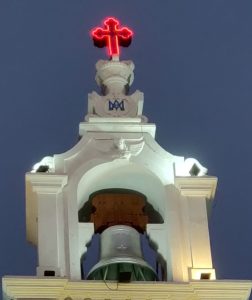
The work on the architectural modification of the frontispiece began in August 1875. Then came the final stage of Costa’s ingenuity. By 26 November, the scaffolding was in position. The massive bell suspended from a pulley was raised slowly to the central belfry specially built for it. The spectators were amazed. Te Deum laudamus was sung on this day as well as on 1 December 1875, when the bell was rung from the apex for the first time.
It was not just another day in Goa. Those engineering feats deserved front-page coverage, except that Goa did not have a daily. In the former capital city, now called Old Goa, preparations were underway for the third solemn Exposition of St Francis Xavier. In Panjim, the new capital, officially called Nova Goa, the city centre was almost picture-perfect, with the Senate’s imposing clock tower building, the public promenade (today’s municipal garden), and the elegant Largo 13 de Junho, now Church Square. Only Corte de Oiteiro was left to complete the scene as it stands today.
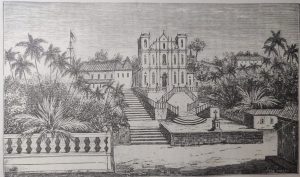
It is quite another matter that a serious mishap tarnished the third anniversary of the installation of the Levachi bell. On the evening of Sunday, 1 December 1878, the third day of the novena to the Immaculate Conception, while the bells were ringing and the faithful were exiting the church, a hook bolt of the main bell came loose and fell on a devotee, Camilo Cipriano Barreto Pereira, causing a deep cut in his skull. According to the Orlim-based weekly A Índia Portuguesa, he was a newlywed native of Raia and an employee of the Military Hospital in the city. He succumbed to his injury 10 days later.
After a few years, the clapper of the bell dislodged, killing a man, and a smaller bell fell off from the tower. In 2018, a similar tragedy was averted, thanks to the alertness of parishioners Samuel D’Silva and John Fernandes. They repaired the sagging bell shaft and the broken clapper of the main bell. ‘We researched a lot before we started on this. We examined many bell towers, particularly that of the Cathedral See,’ said fabricator Silva.
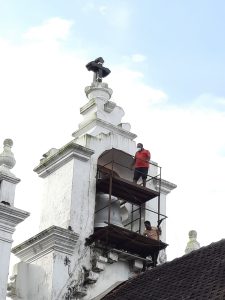
The repairs took three years. Mechanical engineer Fernandes recalled the crucial inputs received from metallurgical engineer Edgar Remedios, fabricators Maria Enterprises of Pilerne, carpenter Mahesh Vishwakarma of Panjim, Rohan Parab of Mahalaxmi Workshop, Bethora, and welding technologist Ramesh Arolkar of Poona.
Fernandes said, ‘It is a joy that with their wholehearted cooperation we were able to complete the work with precision and without any casualty, by November 2021, under the banner of the Immaculate Conception.’ The works were undertaken during the tenure of parish priest Fr Walter de Sá and Confrarias president Pedrito Fernandes.
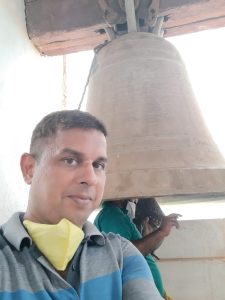
Appreciating the iconic heritage bell, parish priest Fr Cipriano da Silva, opines that the bell has aged as gracefully as the church building itself. ‘Majestically perched almost at the pinnacle of the frontispiece, the old bell not only adds beauty but also increases the faith and fervour of the people,’ he added.
Reflecting on the bell, Fr Haston Fernandes, assistant parish priest, said, ‘A church bell is not just metal clanging to remind the faithful about an oncoming liturgical ceremony. As per the old rite, its ringing has an exorcising power over the parish. We sometimes take our bells for granted. I hope our church bell awakens us spiritually as to what it has been doing every day.’
Panjim’s white icon is now hemmed in by high-rises, yet it remains the city’s best-known landmark. People also connect with its stately bell, which has a calming effect in the midst of an oppressive soundscape. The bell is a constant invitation to heed God’s voice.
Pic credits: 1, 2 – Oscar de Noronha; 3, 4, 5 – Samuel D’Silva
This article first appeared in Herald Cafe, 30 November 2025, p. 1, and, with a few additions, at https://www.heraldgoa.in/cafe/panjim-church-bell-strikes-150/455647/ on 1 December 2025.
I enjoy history especially when it is well-researched and full of details!
I read this ode in O Heraldo yesterday. May Camilo’s soul rest in peace — I immediately thought another horrific incident. A Goan couple and their son were killed on the Siolim – Chopdem bridge, when drunk tourists smashed into their car. The family had attended Sunday mass. The lone survivor — a daughter — was in a bad way. I remember she touched the feet of the local MLA ( a Hindu) after he helped her in her fight with the landlord.
Amazing historical article. Great research! Congrats
Beautiful narrative greatly informative.