Unto God and Caesar
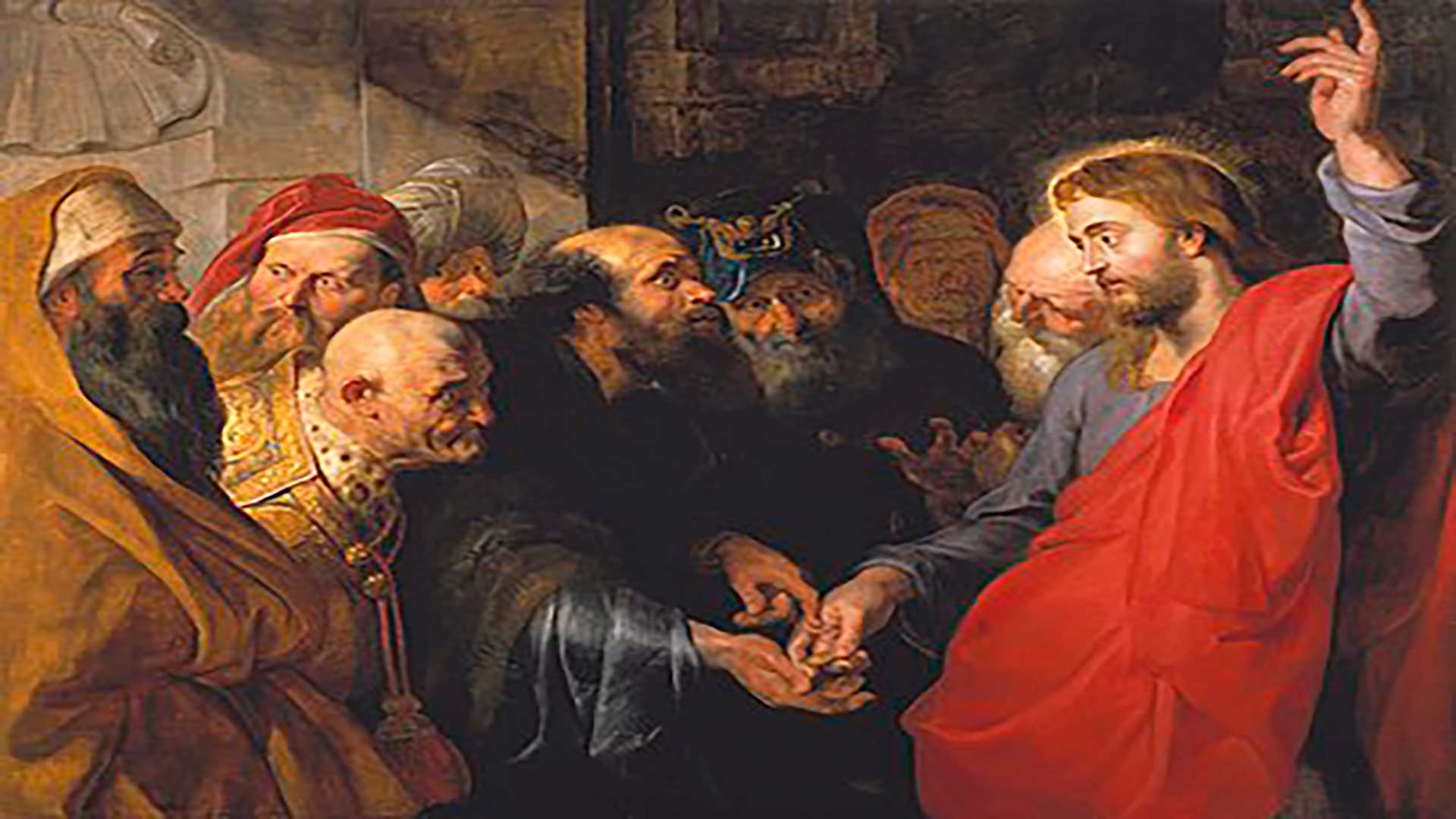
Today’s Gospel (Mt. 22: 15-21) picks up where we left off last Sunday. The wedding feast parable was a subtle attack on the Jewish authorities. Such was their hatred of Our Lord that even two divergent groups did not think twice before they got together to checkmate Jesus: Herodians, who were pro-Roman political opportunists and indifferent to religion, and the Pharisees, who were anti-Roman nationalists, puritanical as regards the Jewish law and traditions. Devising a ploy from which it seemed impossible for Jesus to escape, they got some young scholars to pose the following question with guileless simplicity: ‘Is it lawful to pay taxes to Caesar, or not?’
Jesus was faced with a false dilemma. Whereas to condemn the Roman tax would be to incur the wrath of those pagan rulers, to consider the tax to be legitimate would anger the Jews, who had always resented Roman rule. Seeing through the trick, Jesus asked for a coin, pointed to the image and inscription on it, and promptly replied, keeping his tone light and matter-of-fact: ‘Render therefore to Caesar the things that are Caesar’s, and to God the things that are God’s.’ This brilliant solution exposed the hypocrisy of the Pharisees, who used Roman currency for trade and commerce, yet grudged against the payment of tax; so too the Herodians, who could easily be charged with detracting from Roman authority.
Jesus thus made it clear that, while political masters seek taxes, God seeks souls. Or, as Fulton Sheen points out, ‘Once again He was saying that His Kingdom was not of this world; that submission to Him is not inconsistent with submission to secular powers; that political freedom is not the only freedom. To the Pharisees who hated Caesar came the command: “Give unto Caesar”; to the Herodians who had forgotten God in their love of Caesar came the basic principle: “Give unto God.”’[1]
Does that amount to serving two masters? No. Two masters that we cannot serve at the same time are God and Mammon, for they are opposing concepts; to serve one we often (must) forego the others. For instance, when running a business and making good money, we may think that ends justify the means, to the point of even sacrificing religious worship on Sundays and holy days. On the other hand, serving a legitimate temporal authority is necessary for the smooth functioning of society. While it is quite a different matter if the authority acts immorally and illegally, our basic aim should be to align earthly administration with divine law.
In the ultimate analysis, everything belongs to God, doesn’t it? Hence, in the First Reading (Is. 45: 1, 4-6), God makes it clear that He is the Lord, and there is no other. He is always in control and exercises dominion even over those who do not recognise Him. For instance, God had the Persian king Cyrus put an end to Babylonian rule and freed the Jews. ‘Anointed’ were the kings of Israel alone, but Cyrus as God’s instrument in the liberation of Israel is regarded as anointed, too.
To pay tribute to God, we ought to sing His praises and ‘tell among the nations His glory and His wonders among all the peoples.’ (Psalm) That is to say, we must evangelise. We can do so from wherever we are, whatever be our station in life. We can do so without worrying about what we are going to say, for the Holy Spirit takes charge and guides us. In fact, our actions often preach louder than our words: that is the apostolate of presence.
Meanwhile, the 100th World Mission Sunday being observed today is an apt moment to check on the nature and state of our Missions. Is evangelisation truly happening – that is to say, are we really proclaiming the spiritual message of the Gospel, or have our missions become an exercise in social service? Today's church collection is specifically to support ‘missionary projects’, but are they the same pious projects that you and I have in mind, or has the present orientation different?[2]
There has been a noticeable cultural tendency in the post-Vatican II era to downplay conversions and favour a generalised ‘be a good person’ approach. Several factors have fuelled this shift: one, the new focus on Dialogue, prompted by the Church document Nostra Aetate; two, the idea that all religions are equally valid pathways to God, inspired (though not explicitly stated) by Dignitatis Humanae that asserts that every human person has a right to religious liberty free from coercion; and three, the concept of ‘Anonymous Christians’, as in theologian Karl Rahner’s concept that a ‘good person’ of any faith is basically responding to Christ’s grace. If that is so, what’s the need to be a baptised Christian?
Let us hope that all of this is only a misinterpretation, albeit quite widespread, of the Vatican II spirit. On the one hand, official documents endorse evangelisation; on the other, the ground reality shows that evangelisation to promote conversions is no longer top of mind. There has been a cultural shift since the 1960s, and our religious leaders knowingly or unknowingly play into it. This has caused religious indifferentism to grow much faster in reality than in official documents. It is high time for us, therefore, to reclaim our traditional position with commitment.
This struggle to maintain the purity of the Gospel against surrounding cultural pressures is nothing new. We find its ancient parallel in the Second Reading (1 Thes 1: 1-5). St. Paul, on behalf of his missionary companions Silvanus and Timothy, and himself, informs the Thessalonians of how he and his own pray and thank God for their ‘work of faith and labour of love and steadfastness of hope in our Lord Jesus Christ.’ Such graces are divine gifts that we too need to pray for.
The Thessalonians, newly formed into a faith community, were challenged by paganism all around them. Similarly, modern Christians navigate a neo-pagan world filled with temptations. The lesson to learn, therefore, is to fix our eyes high and remain committed. Giving unto Caesar what belongs to Caesar should not prevent us from giving unto God what belongs to God.
[1] Fulton Sheen, Life of Christ (Bangalore: Asian Trading Corporation, 1984), p. 203
[2] A lay Catholic faithful organisation has appealed to the Bishops of India to stop the menace of theological errors being spread under the pretext of ‘inculturation’: https://youtube.com/shorts/kagBOaVfIj0?feature=share and https://www.saveourfaith.com/
