‘Thou shalt love the Lord thy God with all thy heart, and with all thy soul, and with all thy mind’ (Deuteronomy 6:5) and ‘Thou shalt love thy neighbour as thyself’ (Leviticus 19:18).
While these foundational principles are deeply rooted in the Mosaic law, humanity has struggled to live them out. All too often, we live in ignorance of their unity, or we practice one to the detriment of the other.
Historically, when human hearts grew hardened, lex talionis — an eye for an eye, a tooth for a tooth (Exodus 21:23–27) — became the default setting for justice. Yet, Scripture repeatedly points us toward a higher trajectory. In today’s First Reading (Sir 27:30–28:7), Sirach calls anger and wrath ‘abominations’ that mark a sinner, warning that ‘he that takes vengeance will suffer vengeance from the Lord.’ The proposed antidote is clear: ‘Forgive your neighbour the wrong he has done, and then your sins will be pardoned when you pray.’
To break out of this moral predicament, Sirach urges us to ‘Remember your last days, set enmity aside; remember death and decay, and cease from sin!’ In other words, we must keep the ‘Last Things’[i]— Death, Judgment, Heaven, and Hell — firmly before our eyes. They act as a spiritual lens, sharpening our eternal vision.
From Strict Justice to Infinite Mercy
Sirach’s exhortation about forgiveness aligns seamlessly with the Gospel (Mt 18:21-35). Jesus explicitly stresses that seeking the Lord’s pardon is futile if we refuse to reconcile with our brother.
When the Apostle Peter heard Christ pronounce these foundational tenets of Christian law, he wanted the boundaries clearly defined. He asked, ‘Lord, how often shall my brother sin against me, and I forgive him? As many as seven times?’
At the time, teachers of the law taught that pardoning someone three times was the pinnacle of perfection. Jesus completely shattered this limit, extending forgiveness to infinity.
As Abbé C. Fouard writes in Jesus Christ the Son of God, ‘To make it better understood how rigorously His law of loving kindness must bind our actions, He set before the Apostles’ eyes one of those Oriental courts where the lightest fancy of their monarch can, in an instant, raise up or demolish the most splendid fortunes.
So, then, Charity, much more than Justice, should be the foundation of Christian righteousness, or rather one must be blended with the other! “Mercy and faithfulness meet in one; justice and peace are united in one embrace!” even as two sisters.’[ii]
The Danger of Naive Love
However, we must be careful not to water down Jesus’s commandment of love through indiscriminate, naive application. True love does not mean suspending our critical judgment about men and matters.
Our Lord explicitly exhorted us to be ‘wise as serpents and harmless as doves’ because He knew He was sending us out ‘like sheep among wolves’ (Matthew 10:16). Centuries later, Shakespeare vividly echoed this reality in Macbeth: ‘There’s daggers in men’s smiles.’
The modern world remains stubbornly hostile to God’s Word. In his profound work Way of the Cross, Professor Plínio Corrêa de Oliveira sharply observes: ‘Is it not true that today Our Lord Jesus Christ and His Holy Church are disobeyed, abandoned, betrayed? Is it not true that the laws, institutions, morals, and ways of the people are more and more hostile to Jesus Christ?’[iii]
In the face of such structural hostility, foolish sentimentality must make way for something tougher: righteous anger.
The Role of Righteous Anger
Christ Himself displayed righteous anger when He cleared the temple, driving out those who desecrated His Father’s house. As Fr. John Hardon explains in his Modern Catholic Dictionary, ‘such anger is allowable only if it tends to punish those who deserve punishment, according to the measure of their guilt, and with the sincere intention to redress what harm may have been done or to correct the wrongdoer.’[iv]
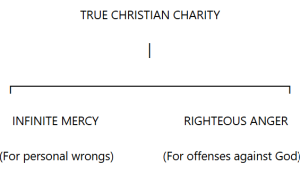
We cannot let ourselves be carried away by a superficial, pop-culture definition of love. Righteous anger against offenses targeting God is not only acceptable — it is laudable.
When St. Paul wrote that ‘Love bears all things… endures all things’ (1 Corinthians 13:7), he did not mean we should accept sacrilege, blasphemy, or evil slavishly and shamelessly. True charity requires us to distinguish between love of self and love of God — between those who love God and those who actively oppose Him.
While we may turn a blind eye to personal offenses, we must stand firm against offenses aimed at God.
Restoring Love to its Proper Place
We must constantly audit our motives: Are we doing something simply because we like it, or because it is genuinely good, true, right, and beautiful?
‘Love’ is arguably the most abused word in the modern lexicon. It needs to be restored to its proper theological place. Authentic charity ensures there is no tinge of personal hatred or desire for revenge in our hearts. Its ultimate goal is to restore things to their pristine, orderly state — paving the way to forgive and, where possible, forget.
Ultimately, we must entrust ourselves entirely to God, praying as if everything depended on prayer and working as if everything depended on work. As St. Paul proclaims in today’s Second Reading (Romans 14:7-8): ‘None of us lives to himself, and none of us dies to himself. If we live, we live to the Lord, and if we die, we die to the Lord.’
Whether we live or die, let our love for God remain absolute, grounded in the profound gratitude that we belong to Him.
[i] See my blogpost “The Last Things – First!” https://www.oscardenoronha.com/2019/11/01/the-last-things-first/
[ii] Abbé C. Fouard, Jesus Christ the Son of God, Goa: Don Bosco, 1960, p. 271-272.
[iii] Plínio Corrêa de Oliveira, The Way of the Cross https://www.tfp.org/the-way-of-the-cross/
A bold clarification on what love entails.
It’s not enough to read and appreciate what you write, it’s important to internalise and practise.
Thank you Mr. Oscar for your profound and clear explanation. We must forgive and yet that doesn’t mean becoming a Christian doormat.
Thank you Sr Oscar for your wonderful analogy. Tolentino