Reap what you sow
Today’s Readings are an eloquent commentary on how modern people should invest in living wisely. The fact that ‘we have no time to stand and stare,’ as the Welsh poet W. H. Davies so beautifully puts it, sets a huge limitation on our physical, social, psychological, and spiritual well-being. We fail to realise how we fritter away our lives when we should only be thanking God for adding life to our days, and not simply days to our lives. Today’s Readings are thus a fascinating eye-opener for our jet-age.
Come to think of it, they are apt for all times, for human nature has hardly changed since its inception, and we, like little children, still need to be reminded of what is good for our health and what is not. The First Reading (Wis 12:13, 16-19) therefore goes back to the basics, showing us the omniscience and omnipotence of our God who, at the same time, cares even for the least of His creatures. He balances justice with mercy, providing an inspiring model for human administrators of all time. In our times of misery, the wisdom of Solomon draws our attention to the comforting reality that there is n-o-n-e like God, Who fills us with hope by forgiving us our sins.
Of course, it is one thing to sing ‘O Lord, you are good and forgiving’ when the going is good; and quite another when our minds are beset by fear and our hearts clouded by doubt. Under such circumstances, do we still have the verve to praise the Lord and trust Him, as Job did? It is not easy, but try we must – and we can rest assured that God will turn and take pity on us. All we need is to have our ear to Jesus's heartbeat.
St Paul in the Second Reading (Rom 8: 26-27) is quick to point out that ‘the Holy Spirit helps us in our weakness; for we do not know how to pray as we ought, but the Spirit Himself intercedes for us with sighs too deep for words.' Several masters of Catholic doctrine, as well as saints of old have taught us, by word and example, that it is essential to trust in divine providence. We can gain insight not only through prayers, rituals, and pious practices but also through our sufferings in the daily grind. It is legitimate to ask for what we want, but we also need to learn to align our will with the will of the Father in Heaven.
Finally, in the Gospel (Mt 13: 24-43), the parable about the Kingdom of Heaven comes close on the heels of last Sunday’s Parable of the Sower. Jesus compares the Kingdom to a man who sowed good seed in his field. Jesus warns us against blindly trusting the world, for its spirit drives a wedge between us and God, just like our enemies do who plant weeds among the wheat we have sown. Consider how many parents today lament the company their children keep! No wonder Don Bosco urged the youth to avoid bad company like poisonous snakes.
The problem of evil, weakness, and death that the parable raises will have its final solution only at the end of times: the Father will have the weeds bound in bundles to be burned, whereas the wheat will be gathered into His barn. It is unknown when this will happen, but then, its delay amounts to opportunities for sinners to repent!
Meanwhile, we shouldn't leave it all to God alone. You and I are obligated to discuss the divine plan of salvation and strive to influence people accordingly. But what have we done concretely in that regard?
Let us not lull ourselves into believing that we are powerless… We have God on our side, yet how fervently do we pray? On the other hand, those who think they are powerful have their days numbered and will soon come to reap what they have sown.
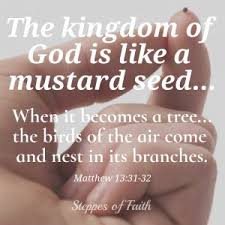
Jesus also compares the Kingdom of Heaven to a mustard seed, which, though the smallest of all seeds, grows into the greatest of shrubs and becomes a tree. Furthermore, He likens the Kingdom to the yeast that a woman has hidden in three measures of wheat flour, until it is all leavened.
While the former parable convinces us that, no matter how poor, humble or seemingly inconsequential we may be, God takes care of our future. In the latter parable, Jesus hints that everything that has been hidden hitherto will come to light through His Bride, the Church. Truth will prevail.
It is therefore fundamental that we continually refresh our understanding of God’s Kingdom. Our aim should be to let His Kingdom come here on earth and have all nations gathered to worship Him. It will undoubtedly be a win-win situation for God and man.
Although the world we live in is a bundle of contradictions, let us not lose heart. We are sinners, yet we are called to be disciples of Christ. We who are made in the image and likeness of God are called to transcend human nature and embrace divinity! We have been endowed with free will and would do well to use it wisely. The bottom line is that we will reap what we have sown.
Banner: https://rb.gy/17fm0
