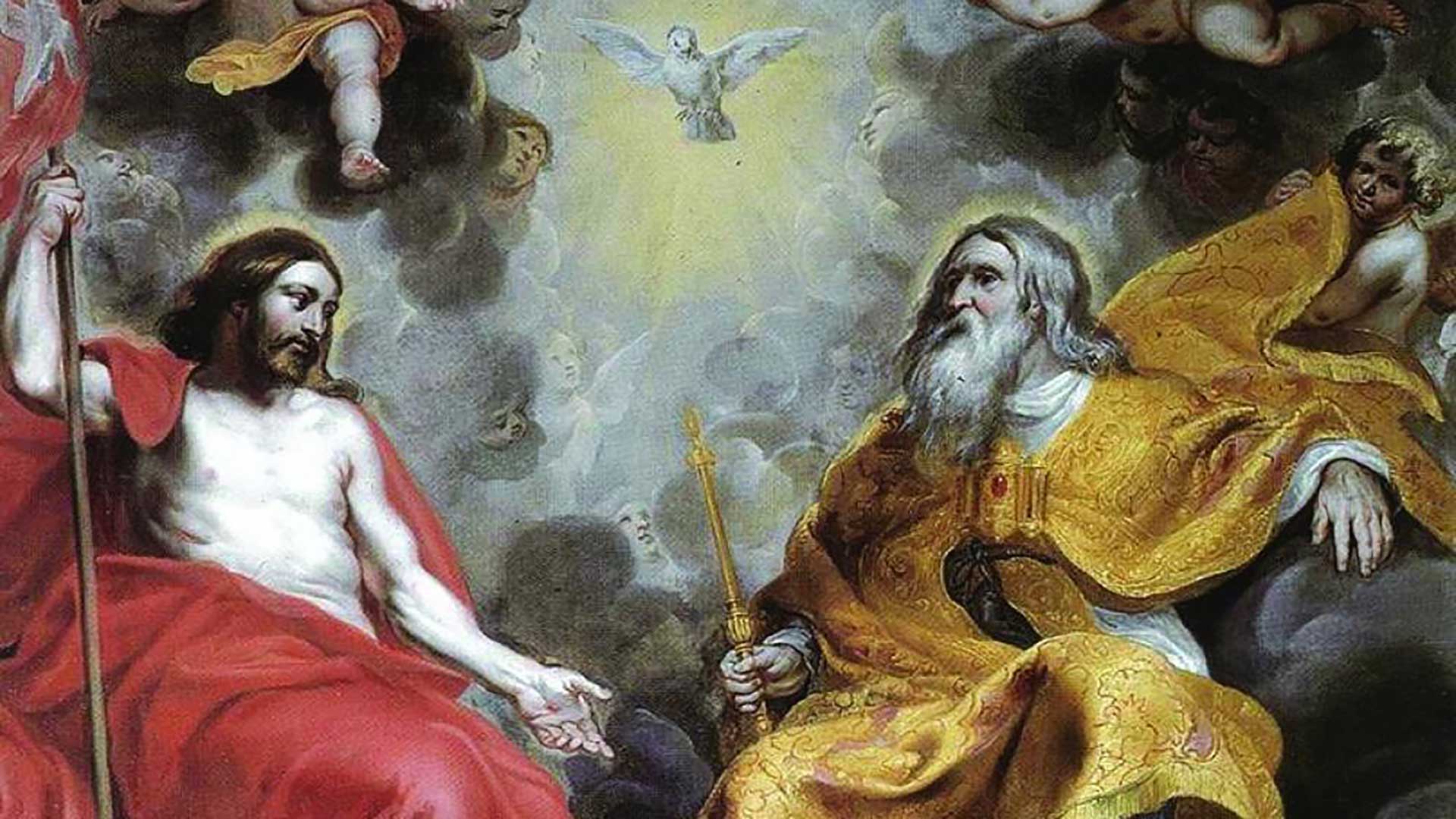
The Holy Trinity, a deep Mystery!
Close on the heels of Sunday of the Holy Spirit comes Sunday of the Holy Trinity, this latter being the central mystery of our faith and life (CCC 234). We believe in one God, who is not alone, solitary, but a Trinity, a Triune God, a divine family of life and love. Just as the Father sent His Only Son, Jesus Christ, the Second Person of the Holy Trinity, to be born in the world, and Jesus Christ, after ascending to the Father, ensured that the Third Person, the Holy Spirit, would descend upon the world, it is only fitting that we honour them all together today, on the Solemnity of the Holy Trinity.
The First Reading (Exod 34: 4-6, 8-9) takes us back to the beginning to witness Moses’ encounter with God the Father. God rightly introduces Himself as 'merciful and gracious, slow to anger, and abounding in steadfast love and faithfulness.'
God's delightful self-description comforts Moses so that he promptly invokes his 'stiff-necked people' (a true description of the miserable human race) who, by relapsing into idol worship, had provoked Moses into breaking the tablets inscribed with the Decalogue. Moses calls on God to pardon their iniquity and their sin, and take them for His inheritance, or say, forgive their shortcomings, restore them to health, and let them be beneficiaries of His love.
In the Gospel (Jn 3: 16-18), Jesus Himself speaks of the Second Person, as follows: 'God so loved the world that He gave His Only Son, that whoever believes in Him should not perish but have eternal life.'
This passage serves as a testament to God’s love and a promise of eternal life for those who believe in Him. In the words of bishop St Cyprian of Carthage (3rd century AD), salus extra ecclesiam non est, or extra Ecclesiam nulla salus, which means that outside the Church there is no salvation.
So, what about 'he who does not believe,' as Jesus put it? God’s love expressed through Jesus – who died to save us – is so great that we lose our salvation if we do not stand by Him and embrace His faith. This is what the Catholic Church has traditionally taught. The current Catechism of the Catholic Church (CCC), quoting Vatican II document Lumen Gentium, states:
'Those who, through no fault of their own, do not know the Gospel of Christ or his Church but who nevertheless seek God with a sincere heart, and, moved by grace, try in their actions to do his will as they know it through the dictates of their conscience – those too may achieve eternal salvation.' (CCC 847)
That is food for thought and discussion beyond the reading of the day!
The Second Reading (2 Cor. 13: 11-13) speaks of the Holy Spirit. St Paul teaches us to greet one another saying, 'The grace of the Lord Jesus Christ and the love of God and the fellowship of the Holy Spirit be with you all.' That’s how the Apostle to the Gentiles ends his letter to the Corinthians; and that’s how we begin the liturgy of the Holy Sacrifice of the Mass. So routinely do we pronounce these words that we fail to appreciate their deep meaning.
The fact is that none can claim to have fully understood the Holy Trinity. But then, 'God has left traces of his Trinitarian being in his work of creation and in his Revelation throughout the Old Testament. But his inmost Being, as the Holy Trinity, is a mystery that is inaccessible to reason alone or even to Israel's faith before the Incarnation of God's Son and the sending of the Holy Spirit.' (CCC 237) The Father is revealed by the Son; the two are revealed by the Spirit (CCC 238-248). The whole divine economy is the common work of the three divine persons. (CCC 258) The ultimate end of the whole divine economy is the entry of God's creatures into the perfect unity of the Blessed Trinity. (CCC 260)
So, how do we proceed from here? Even before trying to delve into the Mystery, we must acknowledge how privileged we are as Christians to have been let into what is indeed the Mystery of the intimate life of God. It is profound, overwhelming, and incomparable! If we have not fully understood it – and we never will – there is nothing to fear. St Augustine tried to reason out, but to no avail; there is that famous story of how a little child set his questions at rest…. Children often say the most insightful things.
On the other hand, what the mind cannot comprehend, our hearts can – faith can. That is how a mother understands her baby who only babbles – with love. And that is how, even with reference to everyday things, we may understand the workings of the Trinity, for God has indeed left traces of his Trinitarian nature in his work of creation. A frequently cited example is the flame of fire, which possesses three characteristics (heat, light, and form) and remains one entity, and cannot exist as a flame of fire if any of these attributes are absent.
Today provides us with an opportunity to meditate on this fundamental mystery of our faith and love and to initiate a personal relationship with each of the three Persons of the Holy Trinity!
