The Challenge of the Light
On Laetere Sunday [1], we joyfully anticipate the victory and the joy that will be ours at Easter. We have progressed through prayer, fasting, and almsgiving, and are half way through Lent. Through the Liturgy of the Word, we have meditated on the human condition and on our response to God’s loving invitation through the ages.
Looking back, on the first Sunday of Lent, the First Reading focused on the creation of the world and the sins of our first parents. On the second, we heard Abraham's call, the father of the people of God. On the third, we read Moses's story of leading his people out of Egypt.
Today, in the First Reading (1 Sam 16: 1.6-7.10-13), on the fourth Sunday of Lent, we witness the rise of David (Hebrew for ‘commander’) as the ruler of the united kingdoms of Israel and Judah. God bid the prophet Samuel to anoint the youngest son of Jesse (‘God exists’) with oil in his hometown of Bethlehem.
Accordingly, David, a shepherd, replaced the first king, Saul, who had disobeyed God: ‘The Spirit of the Lord came mightily upon David from that day forward.’ A millennium later, Jesus (‘God saves’) was born in Bethlehem (‘House of Bread’) and would eventually declare Himself the Good Shepherd. Bethlehem, in the hill country of Judah, was located about six miles north-west of Nazareth, where Jesus lived until he was thirty, and about five miles south of Jerusalem, where He would die, three years later. Thus ended the public ministry of God’s slain Lamb, unprecedentedly full of miracles and blessings.
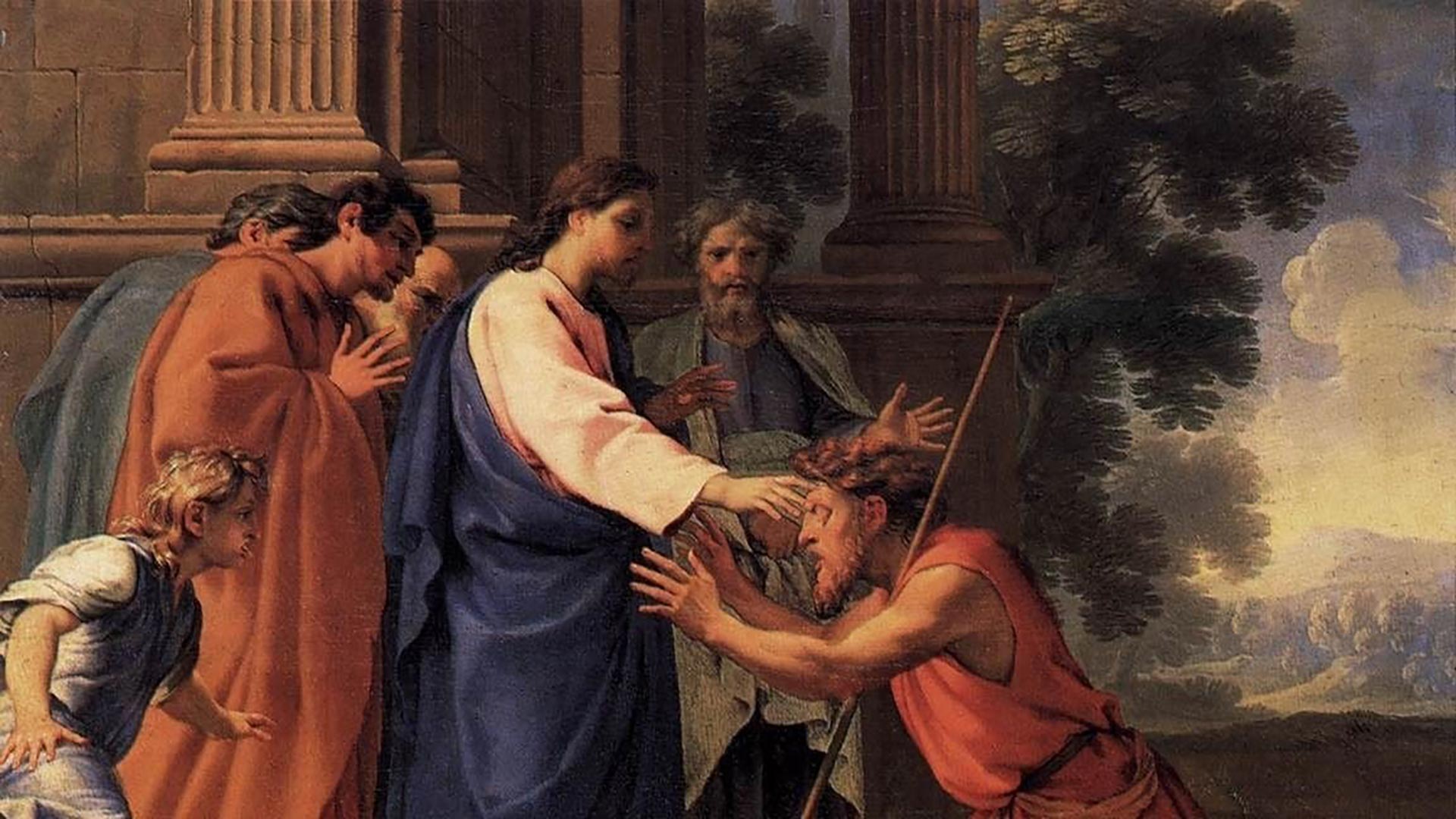
The Gospel (Jn 9: 1-41) speaks of one such miracle or ‘sign’: the cure of a blind beggar. The disciples, keen as they were to know if his blindness was a result of sin, seemed ‘blind’ too. The Master clarified that 'it was not that this man or his parents had sinned, but that the works of God might be made manifest in him.' Jesus, proclaiming Himself the 'Light of the World', sent the blind man to Siloam (meaning, ‘Sent’).
That was incipient baptism, carrying as it did a promise of sweet light and refreshing health to the weak and suffering.[2] Once cured, the man called Jesus 'a prophet' and later acknowledged Him as the Son of Man. Clearly, he had received not only natural sight but also supernatural light!
Overawed by this occurrence, the local cabal began to work overtime and close in on Jesus. The Pharisees spread a canard: 'This man is not from God, for he does not keep the Sabbath.' No doubt, Jesus had cured the blind man on a sabbath, but, as He had said elsewhere, 'the Sabbath was made for man, not man for the Sabbath. So, the Son of Man is Lord even of the Sabbath.' (Mk 2: 23–28)
However, far from recognising Him as the Messiah, some Pharisees argued that he who has not kept the sabbath cannot be of God. Whereas they kept pressing the cured man, expecting him to retract his earlier statement, the grateful man retorted: 'You do not know where He comes from, and yet He opened my eyes. (…) Never since the world began has it been heard that any one opened the eyes of a man born blind. If this man were not from God, He could do nothing.'
In view of such irrefutable logic, the only thing left to do was hype the case against Jesus. The parents were called upon to make sure if their son was congenitally blind; they did, but since 'the Jews had already agreed that if anyone should confess Him to be Christ, he was to be put out of the synagogue,’ they pleaded ignorance as to the author of the marvel.
That was pure blackmail! Alas, how many do the same today! They swim with the current, compromising their principles, so as to gain social acceptance and political mileage. Likewise, arm-twisting and intimidation are rampant; it is the same old story of giving a dog a bad name and hanging him!
At that time, Jesus was at the height of his ministry — but also at the threshold of his Passion and Death. The Light of the World was shining in the darkness, yet the world did not know Him (cf. Jn 1). The cure of the blind man shows Jesus to be the Messiah, who came into the world 'that those who do not see may see, and that those who see may become blind.' That is, His light was 'as mighty as to enlighten the lowly as it was to dazzle and blind the proud.'[3] To the Pharisees, who felt targeted by this powerful proclamation, He said that only physical, not spiritual, blindness could be excused…
In today’s topsy-turvy world, one sees the right-minded being banished, while the flawed get promoted. But we are not to be frightened or discouraged. By our baptism, we have been invited to cross from darkness to light, from sin to supernatural life. St Paul in the Second Reading (Eph. 5: 8-14) exhorts us to 'walk as children of light (for the fruit of light is found in all that is good and right and true), and try to learn what is pleasing to the Lord. Take no part in the unfruitful works of darkness but instead expose them.' Persevering in this mission through life is indeed the challenge of the Light.
[1] So called from the first words of the Entrance Antiphon for Mass, "Laetare Jerusalem" ("Rejoice, O Jerusalem")
[2] Abbé C. Fouard, Jesus Christ the Son of God. Goa: Don Bosco, 1960, p. 290.
[3] Op. cit., p. 293.
